Unknown's avatar

About Robert Johnson

English teacher since 1997. Worked in High Schools in Yorkshire till 2005. From 2012 have worked in FE establishments. From January 2015, worked in Adult workplace training delivering Funky Skills Maths and English.

New Exams Are Here – Paper 2

Okay, so you have taken the first new style GCSE English paper and you are preparing for the second one. What should you expect?

AQA have an example on their website. Here it is, broken down for you, to knock all those fears on the head.

2017-05-07 (23)

2017-05-07 (24)

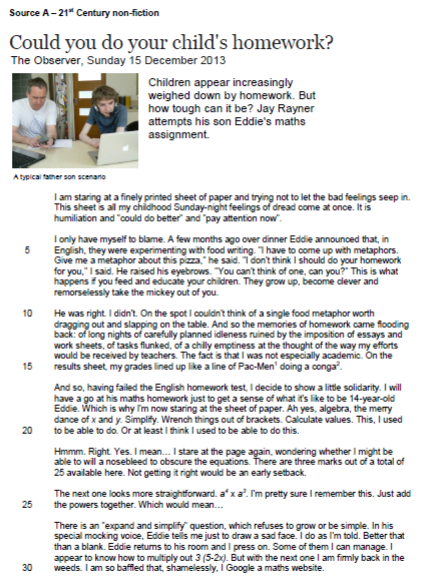
These first two are the first external source, like the ones of old, but instead of 3 of them, there are only 2 to read and answer questions on.

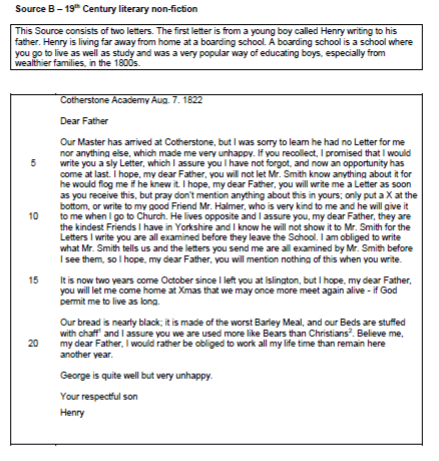
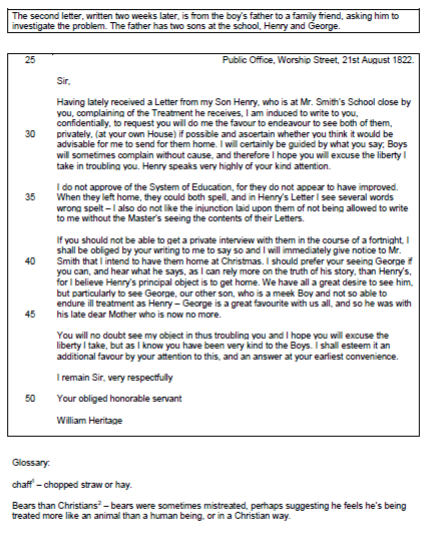
The second one is below…

2017-05-07 (25)

2017-05-07 (26)

So, above are the inserts you are required to read for this exam. You have 15 minutes to read through them and check the questions or tasks that need to be answered.

2017-05-07 (35)

Once again, look at this front page. Note the times are the same as Paper 1, the marks the same, how you are assessed on reading in Section A [PEED chains etc] and on your writing in Section B [SPAG marks included]. No dictionaries allowed.

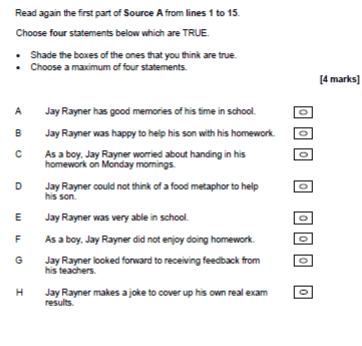
Then look at the first task. This is new.

2017-05-07 (36)

It is simply a case of shading in the right areas. But make sure you get it right. Facts are one thing. Opinions are another.

2017-05-07 (37)

If the first task is worth 4 marks, then 4 need to be shaded but now this is worth 8 marks so even though a summary is to be written, it has to be done clearly and properly. Could you get away with a line down the middle of the page and ideas from both men on either side?

I think not! As a marker, there is no way I would mark high if this happens.

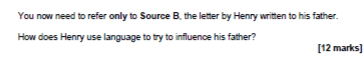
Then comes a question that asks you to refer only to Source B.

2017-05-07 (38)

It is another of those “how does the writer use language” exam questions but note please, the marks have gone up to 12, so 6 good points fleshed out by 6 good quotes and developed explanation and all should be well.

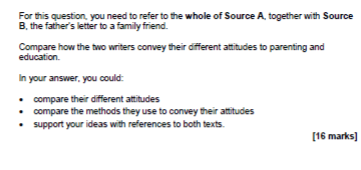
Then comes this… worth 16 marks. Note how the marks are going up each time.

2017-05-07 (39)

Now, we get to something that we are used to in the past, a ‘compare’ task, where you have to show how both people do certain things in their writing. For 16 marks, I would expect 8 good, well rounded points with 8 equally good quotes, well used and well explained, in extreme detail.

This will be the question that makes the difference in this section of the exam!

With this done, section A is complete and yet again, the same [or similar] time management structure applies as in Paper 1. That would be 5 minutes for Q1, 8 minutes for Q2, 12 minutes for Q3 and 20 minutes for Q4. I would advise this slightly different time frame because of how the marks are different for each question as compared to Paper 1.

Then comes Section B.

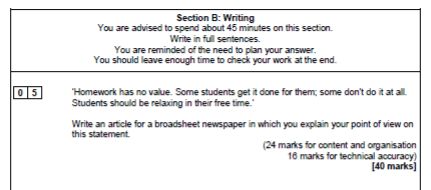
2017-05-07 (40)

As in Paper 1, you have a single written task to plan and execute well. Paper 1 was creative writing in Section B. This is more argumentative and therefore, more difficult. It sets the premise that homework has no value and should be banned. 24 marks are given for ideas on page, how well thought out etc. 16 marks are for spelling, punctuation, grammar, paragraphing [see 2 rules for paragraphing and stick to them] etc. You can so easily write a good set of ideas and write them poorly and score very low on this part of the exam, if you do not paragraph your work clearly, with indented paragraphs and no lines missed.

NB: Write it as you would type it and enjoy doing the resits in November or doing the entire GCSE again the following year.

The task asks you to explain your point of view about homework and its merits. Yes, of course, some students do not do it and are chased by teachers all year long. Others get older ones to do it for them and do not learn. But on the other hand, homework is something that can aide learning, if used correctly. So, plan and prepare on the first page in section B and then write the thing well.

Once again, an easier exam than in previous years, in my humble opinion and one I would relish having a go at, if only I was a student again.

Remember: Be brave. Be the best. Let the markers have all the stress!

New Exams Are Here – Paper 1

Have you been fretting recently? Have you been concerned about the style of the new exams? If so, read on, for this is the first sighting of the new 2 paper style of GCSE English, taken from the AQA website. Below appears a series of photos and then a short explanation, for anyone to understand. I hope they make sense.

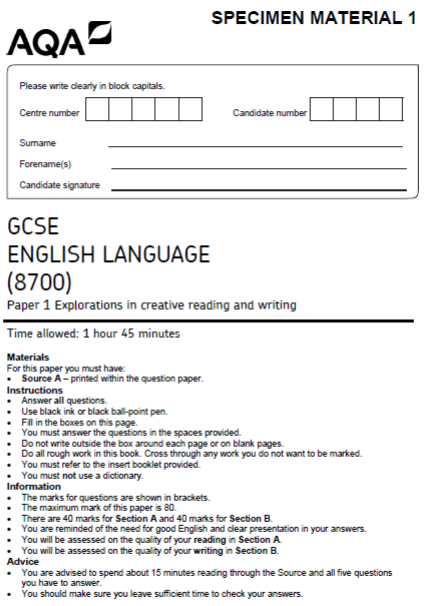
2017-05-07 (27)


This first one is the new formatted front sheet to Paper 1. Note the 1 hour 45 minutes. Note also that the inserts we are used to are included inside the exam paper. Only when we get to Paper 2 do we see external inserts to quote from. Note also how the marks are split and the 15 minutes reading requirement. That is not 1 hour plus 15 minutes. It is 15 minutes to read the inserts and 45 minutes for each section. Less writing, fewer pages but a greater need for accuracy.

2017-05-07 (28)

2017-05-07 (29)


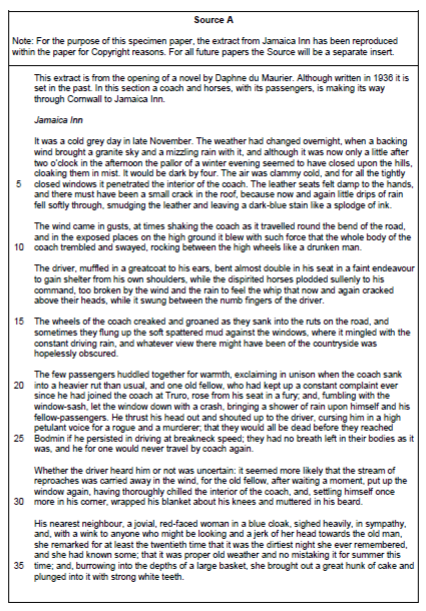
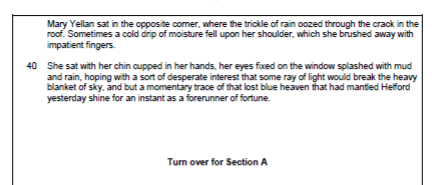
The two pictures above are one insert, from a story by Daphne Du Maurier and are to be read and then, students are to answer questions. Below is Q1.


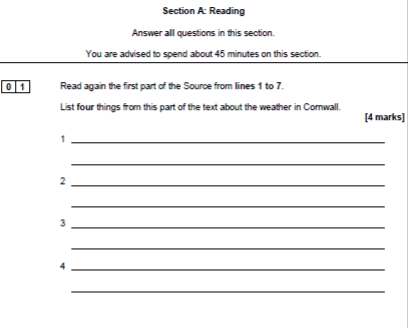
2017-05-07 (30)

Can you remember the first task on the F paper from last year and the years before? That was a simple list of four things. This is the first question, an easy one to get you into the paper. 4 things means 4 points. Only write two and you only score two. Simple!

Then come the harder questions.


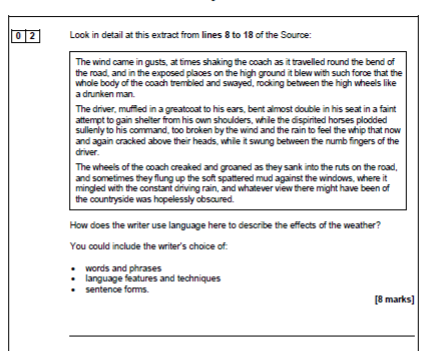
2017-05-07 (31)

This is one of those “how does the writer use language” ones, where you have to mention any stylistic devices used, any alliteration, similes, metaphor etc. This is where the PEED chains begin. Note the amount of marks has just doubled, so 4 points made, 4 bits of evidence and lots of explanation and development and you get the full 8 marks. A half hearted effort here can mean the difference between one mark and the next, a 4 and a 5, or even higher.


2017-05-07 (32)

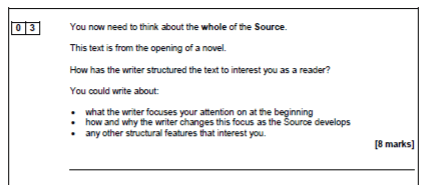
Then you get Q3, which is again worth 8 marks. This one asks about writing structure, how attention is focused by the writer to the reader, about how and why things change at some point and any other features you see and can make mention of. So far, in 3 questions, you have the chance to score 20 marks.

Then this happens.


2017-05-07 (33)

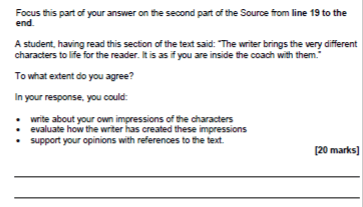
This question is now worth 20 points so here is where you will lose some marks if you mess it up and do not write what you should.

It is based on an opinion of how the writer brings the characters to life. Now, it does not matter whether you agree with it or not, what you have to do is write about it, so do not get hooked up on agree or disagree. It asks how far you agree, so you have to think where you stand on the matter and then write a balanced argument for what you think to be the case. It says you have to support your ideas with reference to the text, so PEED chains still in operation.

With the first 15 minutes of reading time and these 4 questions to answer, you are forced into a time frame as follows:

15 MINS – READING

5 MINS – Q1

10 MINS – Q2

10 MINS – Q3

20 MINS – Q4

And when that is done, you have done the new Section A of the new first exam!

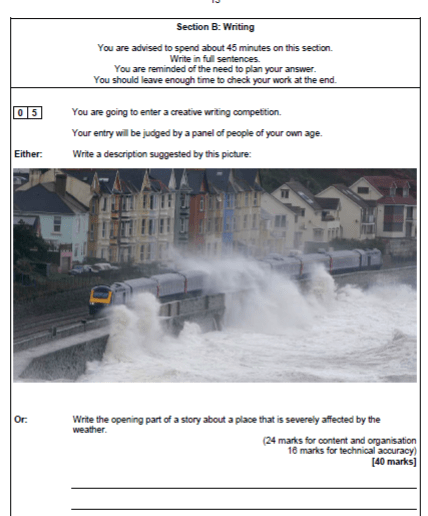
Now, in the past, Section B has been 2 tasks; one worth 16 marks and the other worth 24, with 25 minutes and 35 minutes being advised for each one respectively. Here, your Section B is a single task of 45 minutes [and that includes planning].

Power of Y planning takes 5 minutes, so you have 40 minutes maximum, to write the thing, but what is it to be?

See below….


2017-05-07 (34)

You have a choice of 2 tasks, not the other thing that I am sure will happen [where some berk will try to answer both tasks in 45 minutes – it has been tried before now so please just do one task].

Your either/or in this instance is really a brilliant one when it comes down to it. If you chose the description based on the picture, then you have all the imagery there in the picture to be able to plan and write a lovely descriptive piece. If you chose to do the second one instead, where you have to write the opening part of a story about a place that is severely affected by the weather, then the options are limitless and this is why the new exam is trying to do that for you as student.

Think for a second!

Pathetic Fallacy and Foreshadowing allow you to begin with bad weather, rain, gusts of wind, leading into a possible ghost story like The Woman In Black. If you are a Doctor Who fan, then episodes like Knock Knock come to mind, or Blink, where there is rain. Or perhaps, you choose something that you know. I went potholing once down something called Jack Pot [yes, it was called that] in Derbyshire. It is literally a 5 foot hole in the ground that you climb down, but if it rains, it fills up, so my story could be about a potholing disaster where the hole fills with unexpected rain and how the adventurers try to survive against all odds.

With all this done, you have completed your first new style exam. In essence, it is a lot easier than the previous ones of years gone by, so I foresee raised levels of success. If teachers, like me, do their job right as they prepare their students for this, then percentage rates of 5 and above [4 = C of old] will forever increase, so long as the government do not have heart failure and knee jerk their way into something else.

So do not panic. Be brave and prepare for Paper 2 [see next piece on this site].


Trouble at ‘T Mall

If you ever wondered why John Cooper Clarke finds his way into anthologies with his poems, here is why, seen today on social media. His words are simple, straightforward, funny as hell and brilliantly played.

GCSE English: The Myth Buster #1

GCSE English is never meant to be easy but the government, in their wisdom, have made the exam boards here in the UK make some changes this year. Two of these are discussed below.

#1. The 9-1 Marking Scheme

Since the arrival of the linear exam, where no coursework and no marked speaking and listening is taken in to account [SL still is done but with no points], what you as a student are left with is a total examination mark, but now, instead of one exam, there shall be two. Exam boards differ but generally, they all follow similar guidelines.

The old way of doing things was A* through to G and a U if you came for two hours and wrote your name [you know what I mean]. A grade C has always been the benchmark for the next step, for going on to AS or something else or not even bothering. “I need a C” has been the stressed statement from students all my teaching career. On average, I have helped 84% get that C but I despair for the other 16% who did not get it. You see, they worked hard and got the grade they deserved.

Now, we have the 9-1 system and no one seems to know what a C grade is any more. Newsflash folks! No such thing as a C grade any more. No point in clinging on to the C grade for it will not return. Now, you have to concentrate on simply scoring the highest number you can overall, which leads me to the next point; no texts allowed in the exams.

#2 No Texts Are Allowed Now In The Exam Mum, Honest!

I wonder what your reaction was when son or daughter came home, or when teacher said this…

No need to fret.

See this below and really take a hard look at it several times. It is important.

18121678_10210860937056815_234445692806667130_o

I am having heated discussions with friends and acquaintances who have GCSE year sons and daughters who are moaning at me [as if I am the reason it has happened] saying why is it that students are not allowed to take their poems into the exam any more, or why can’t they take their Shakespeare text in? Or why cannot the school provide students with clean, unmarked copies of the poems any more? How is my son going to remember an entire Shakespeare play at his age? How is my daughter expected to know 15 poems completely, in her head, so she can quote from them? The stress is too much. This is the point when the arms and hands are waved wildly out of  control like Kermit the Frog losing it with Miss Piggy.

But there is no need to stress at all! Ask why the parent screams that. Possibly because they got all the help they needed. Ask why the student screams it. All sorts of answers are available, some good and some not, but there is no need to stress at all.

Here is why.

If you look very closely in the picture above it uses the word “and” right in the middle of each one. It first says that dependent on which it is; Shakespeare or the 19th Century Novel, there will be an “extract.” No need for a book for that is there? You answer the question based on what you see in front of you. Then, you answer using the rest of the knowledge you have of the play or the text. Some folk are screaming blue murder about this. It’s too hard for my daughter. It’s too much stress.

No it is not. Not if they learn how to do this properly!

Now, ask yourself this question and answer it honestly, but who goes into an exam about Romeo and Juliet, or Macbeth, expecting an extract comprehension and does not know what happens in the rest of the play so they can write that little bit more into their answer? You have to either have not studied [sickness for example] or had some reason why you have not got your head round the book. The other person is the one that in class has “swung the lead” and not really tried and then, when told by their teacher that there are no texts included to help them, they panic, which leads me onto the next point.

#3 To Panic, Or Not To Panic…

There is absolutely no need to panic about any of these two exams. Let me show you why with a randomly found bit of text from Macbeth.

2017-04-27

This is the bit where Lady Macbeth gets the letter from her husband who when she saw him last, was Thane of Glamis. She reads, before this, that King Duncan has made him Thane of Cawdor [more title and lands] and that three weird women were involved [witchcraft element] in the foretelling of it. She then says farewell to a servant and thinks this on her own, on stage. Thoughts are silent on stage, so a soliloquy is used, whereby she shares her thoughts out loud.

“Come ye spirits,” she says and then later adds, “Unsex me here.” She is asking that all her female nature be taken away by the spirits [evil elements of the spirit world] and that everything that makes her sensitive be gone, for she wants her husband to now become King after she [see later in text] kills the King when he visits later in the play.

She is hatching “a cunning plan” as Baldrick would say in Blackadder.

Now, your question in the exam would be a twofold one. The first part would say something like Show how this extract shares Lady Macbeth’s feelings at this moment in the play and then it might say and with reference to the rest of the play, show how those desires are played out.

Clearly, this is a question that gives you ample opportunity to write in those glorious PEED chains but as you do, all you have to do is add that later in the play, these emotions and feelings turn sour because as much as she wants her femininity taken away from her, that can never totally be done and so, she feels the guilt, sleepwalks, says “Out damned spot” and finally goes insane at what she has pushed her husband into doing [by now he has killed the King, not her]. So the quotes from the rest of the play can be learnt but do not necessarily need to be used in the other parts of the play bit of the question. The only parts you need direct quotes are the one quote I would say to memorise from each major character and those in the extract given at the beginning, which of course, you will or should, be able to annotate.

What about the poems? I can hear the screams now. 15 of them? Well here is the answer, from a student son of a friend who I asked last night how his school is handling this. His Dad sent me the SMS.

18136772_10210867259054861_172704401_n

Once again, does the word “conversant” mean know them rabbit fashion? [for those in the wider world that means perfectly] No it does not! It means know about them, be able to talk [write] about them, be able to share that in My Last Duchess, there are similar themes to this one as well etc.

What it does say however, is that there will be some poetry provided for you all. So, like the English Lang exam, as well as the Lit example above, you shall be quoting directly from a source material in front of you, adding what you know about the rest into the answer throughout the answer.

Now, do you know your section of poems? My students do and could write about them without seeing them. By exam day they will be able to use short quotes they have learnt from them and the only way to do that is to voice record them and then play them back. Your Ipod music for the next 6 weeks or so, is therefore not Rap or Hip Hop, but Poetry! Believe me, it will do you good.

#4 Good Luck!

I never say this to my students. Instead, I say that “luck is for those who are not prepared.” Think about that last sentence for a few moments.

Revise. Learn. Remember and do it well. Then do the exam. If, at the end of the exam season, you can say “I did my level best there” then we as teachers can never criticise and you should not either.

Be the best. Do your best. Let the markers have all the stress!


Writing To Persuade – Section B

I asked a student to complete a Section B task from a past paper, in preparation for his coming exams. It was a writing to persuade piece where he had to try to encourage other college members to go green, or greener than they already are. Names have been changed to be protective so he does not get into bother.

He had to write the text for an article. I was rather impressed! I particularly love the sarcasm/humour of the first paragraph.

Make Ashford Hall Green Again

In recent years, climate change has irreversibly increased by 30%. Is there anything you could do to prevent this? Well, you could recycle this leaflet now, or you could read it all through first and then recycle it. They both sound like great ideas, but I suggest you read it all the way through first and then decide.

Did you know?

In the past 10 years, we have put 75% of all our recyclable materials into landfill; these materials could be reused as something different. For example, this leaflet is made from other recycled leaflets, recycled by people just like you to help us help the world.

30% of everything put into recycling bins are non recyclable.

Every day, thousands of plastic bags, lightbulbs and electronics are put into recycling bins, ruining the recycling process and delaying it, taking hundreds of man hours to sort through all of this non recyclable waste whereas it could take just 2 seconds for you to take a look and realise that “that Tesco’s bag doesn’t belong there!” or “This broken speaker won’t recycle” and to put it into the general waste bins.

How it works

Recycling has many different processes, one of which is the process of recycling plastic drinking bottles: after being collected and separated by colour and material via infrared beams, the bottles are then shredded and melted, before finally being flaked into small plastic pellets to be melted down again into more plastic bottles for later use.

How can I help?

Our goal is to help reduce climate change one school at a time! You could help us with this by asking your college to insert recycling bins throughout the halls.

You could help as an individual by checking through your rubbish before you put it in the bins, reuse bottles, or paper and try to fix your broken electronics instead of attempting to recycle them without thinking.

You could also help us by funding our website. For more details, please go to: http://www.ashfordhallgreeninitiative.co.uk/fundus 

Macbeth: Act 1 Scene 5

Macbeth: Act 1 Scene 5

I was struck earlier today by a comment my student made in our tutorial session, whereby he mentioned that Lady Macbeth is the driving force behind Macbeth killing King Duncan in the great Scortish Play, as it is known by superstitious actors who refuse to say the name. I am no such animal.

In this scene, a number of things happen but a lot of students do not fully grasp what Lady Macbeth is saying when she asks the spirits to come and “unsex her.” Like with any kind of analysis, there is a danger of just thinking literally, that she wants to have all her female sex taken from her. It is one of those moments when we read this in class, from this teacher’s perspective, when 14 boys and 16 girls all give different responses to those words. The girls gather their lips together and there is a sharp intake of breath, usually, whereas the boys usually titter out loud, sometimes making some form of saucy comment. Such is life in the English department in most High Schools and Academies across the country.

So, what is she asking? Here is the text for you….

LADY MACBETH

Give him tending;
He brings great news.

Exit Messenger

The raven himself is hoarse
That croaks the fatal entrance of Duncan
Under my battlements. Come, you spirits
That tend on mortal thoughts, unsex me here,
And fill me from the crown to the toe top-full
Of direst cruelty! make thick my blood;
Stop up the access and passage to remorse,
That no compunctious visitings of nature
Shake my fell purpose, nor keep peace between
The effect and it! Come to my woman’s breasts,
And take my milk for gall, you murdering ministers,
Wherever in your sightless substances
You wait on nature’s mischief! Come, thick night,
And pall thee in the dunnest smoke of hell,
That my keen knife see not the wound it makes,
Nor heaven peep through the blanket of the dark,
To cry ‘Hold, hold!’

She is saying a number of things here. The first is that she wants something to come to her. She calls them “Spirits” which usually means something from the deepest depths of hell itself. Now whether or not you believe in such things is irrelevant for the people in the days of Shakespeare, most notably King James I, did and so what was written was for an audience who would jump at such a comment. To use a more modern example, it is written like the scene in the film, Poltergeist, where the little girl shrilly says, “They’re here!!!” The effect on the audience would have been palpable at the time. It is meant to be the same today but we do not believe in things like that to the same extent any more.

So, she wants the spirits to come and “unsex” her, but what does that mean? Does it mean to take away all her sex? What then, does that mean? To answer that, you need to think about why old fashioned phrases like “the fairer sex” and “the weaker sex” were used on women through the ages by men, in our patriarchal society. For ages now, men have believed women to be weaker than men, fairer in their ways. Or, to put it more correctly, women have the capacity to love more, to be more tender, more able to show compassion and whilst this is true, even today, when one kills someone, it means you are stepping over the line from what is natural and good, into what is heinous and evil. So, before this speech, she is reading a letter from Macbeth about the witches and their prophecy and she is reading how they said Macbeth will later become King.

She knows that for him to become King, the current King has to die. She also knows that her husband has “the milk of human kindness” in him, or that he is too damn soft to be able to kill a King as good as Duncan to fulfill the prophecy. But she is not prepared either, to wait for King Duncan to croak. No, here is a woman who is driven by what she has just read. Thane of Glamis [pronounced Glarms] becomes Thane of Cawdor, just like the Weird Sisters said he would and then will become King. To her, the questions are when and how. So, she hatches a plan for her to kill Duncan at her castle in Inverness. Read the scene above and before you get to the bottom line, you will see what I refer to.

So, when she says “Come, you spirits that tend on mortal thoughts, unsex me here and fill me from the crown to the toe top-full of direst cruelty,” she is asking for everything that makes her a woman to be taken from her. Take all my tenderness, compassion and love and turn it top to toe into “direst cruelty” so that she can commit the horrible act. “Make thick my blood,” she says and “stop up the access and passage to remorse” referring to the way we do something wrong and then feel guilty. She wants none of that. She wants Queenship and at any cost. She does not want the “compunctious visitings of nature” to come upon her [her natural state in other words] to “shake [her] fell purpose.” Her purpose now is to secure the throne for her husband.

Now, I wonder how many wives would get a letter like she does and then plot to kill the King? It is a nasty thing to do indeed; treasonous in every way. But she wants to be able to plan and execute the killing and then act as if there has nothing bad happened at her hands. It takes someone very special [in the vilest manner] to be able to kill another. So she calls on these spirits to “come to my woman’s breasts and take my milk for gall.” She is asking for her milk to be dried up. She wants no sign of moistness, or softness, no sign of female femininity getting in the way of what she has to do. So, this calling on these “murdering ministers” [note too the alliteration throughout this] is a sign that not only does she believe in such things like witchcraft [note the term used mentions a witch = female, another widely held belief at the time], but she is also willing to have them come and take control of her. That is what she is asking for here.

Another more modern take on this would be that she is telling herself to ‘switch off’ everything that she has about her personality that makes her tender, so that she can do the deed. She cannot wait for the night almost [note the night symbolizes darkness, which in turn symbolizes evil] and says “Come, thick night” with all your mist and fog [remember pathetic fallacy here?] as if to summon up the hosts of hell herself, to make such a change in her as to be completely overtaken by the demons she is calling upon. In essence, this will make her have no memory of what is to follow.

Now we all know that even though she calls on these spirits to work in her and to take away all feeling from her, she does go off the deep end towards the end of the play and kills herself, proving that she is not successful in summoning up enough reserve to kill the King. There is some element of softness still in her that festers and sends her mad with grief at what she has done.

See her wringing her hands before her death and wonder why.

So, when we assess what it is that Lady Macbeth is asking for here, do not get stuck on the idea that all this is to do with is some sexual thing. Seeing the greats like Dame Judi Dench act this scene [there are many different ones on on youtube] will make a young lad think one thing because of where some actresses use their arms and hands all over their bodies, but there is more to it than that because she then utters these words: “And pall thee in the dunnest smoke of hell, that my keen knife see not the wound it makes.”

MY CRUEL KNIFE!

At this point in the proceedings, she is the one with murder on her mind. She is to be the killer, according to these words. It is only later that things take a turn and Macbeth does the deed. At the end of this scene, or this excerpt at least, what we see is the desire of Lady Macbeth, the true villain of the play, desiring one thing, being prepared to use sorcery and witchcraft to get what she wants and someone for who becoming Queen is more important than life itself. She may ask for the spirits of the Underworld to come and tear her apart, taking away all her tender, feminine side, but what she does not realise is the danger she is putting herself in. Our lesson for the day then, is to be careful when analysing anything, for there is always more than one way to interpret a line of poetry, or in this case, the text of a Shakespeare play.


She Walks In Beauty – Lord Byron

She Walks In Beauty

She walks in beauty, like the night
Of cloudless climes and starry skies;
And all that’s best of dark and bright
Meet in her aspect and her eyes:
Thus mellow’d to that tender light
Which heaven to gaudy day denies.

One shade the more, one ray the less,
Had half impair’d the nameless grace
Which waves in every raven tress,
Or softly lightens o’er her face;
Where thoughts serenely sweet express
How pure, how dear their dwelling-place.

And on that cheek, and o’er that brow,
So soft, so calm, yet eloquent,
The smiles that win, the tints that glow,
But tell of days in goodness spent,
A mind at peace with all below,
A heart whose love is innocent!

Analysis

Have a look at this video clip before you read any further.

https://www.youtube.com/watch?v=I_zCOJOgd4U 

When it comes to poems, this is one of the most quoted poems of all time, especially the title. Anyone who is anything in the world of literature has heard the phrase “she walks in beauty as the night.” Mega famous poetry at its best! But what is it actually about? What is going on with some of the language in there? It does sound dated and faded by today’s more harsher standards doesn’t it? I mean, even the title seems a little off putting to a modern audience.

“She walks in beauty, as the night….” Can someone come up with a better, more trendy title please?

But I digress and I jest. It is a poem worthy of your time and it is about the innocence of a loving heart. It starts with those now famous words, “She walks in beauty, like the night,” so we know it is about someone the poet either loves, or admires from afar even or even has just met for the first time. He was a romantic poet after all. She walks “in beauty” signifies that she is a true beauty indeed, something special in Byron’s eyes and walks in this state of grace, “like the night.” But the next line gives more depth to this wonder he knows, for we see the words: “of cloudless climes and starry skies.” When there is not a cloud in the sky, the vision before us is wondrous to behold, when the stars are fully out and you can see the wonders of creation, however it came about.

This is someone beautiful indeed.

But there is more when it comes to her description, because “all that’s best of dark and bright meet in her aspect and her eyes.” The word “aspect” is a reference to her looks, her manner, her whole way of being and as far as Byron is concerned, this is perfection indeed. She might be an average lady he knows, by our standards, but his love covers that and he sees her as a vision of beauty, his muse almost, the thing that inspires him to write. We poets need to have something happen for us to feel inspired enough to write a poem.

All that is good, all that is graceful. All that is wondrous. That is where he places his love upon the brow of this unknown lady. She is “mellow’d to that tender light which heaven to gaudy day denies.”

byron_george_gordon_noel

These are odd words by today’s standards of English so we have to treat them as an example of archaic language even if there is not an example of words like “thee” or “thy” to put us off reading it. Then we get the words, “one shade the more, one ray the less, had half impair’d the nameless grace which waves in every raven tress, or softly lightens o’er her face; where thoughts serenely sweet express how pure, how dear their dwelling-place.” They seem too hard for some people, which is another reason why I despair at the modern exam boards putting poems in that some will be able to read and understand, but where the rest will struggle and be put off poetry altogether. There are examples of poems that could be studied that would help the people of this planet to appreciate poetry more, even as good as this one is.

But as much as the rest can be confusing, what you need to get in your head is that this is a love poem par excellence, that was written just after Byron had met a young lady at a party one evening. A short google search on wikipedia, as dodgy as wiki can be, will give you these words:

She Walks in Beauty” is a short lyrical poem in iambic tetrameter written in 1813 by Lord Byron, and is one of his most famous works. It is said to have been inspired by an event in Byron’s life; while at a ball, Byron met his cousin by marriage through John Wilmot.”

But then, if you type in a slightly different request into Google, you get this…

“Lord Byron was the 6th Baron Byron. The poem was written in response to seeing his cousin, Lady Wilmot Horton, in a mourning dress at a party of Lady Sitwell’s on June 11, 1814. The poem was written by the next morning. It was published in Hebrew Melodies in 1815.”

So this begs a question then, one which has been asked for some time and will be asked for some time to come. It is a simple question and it is this. Is there such a thing as love at first sight?

I can answer that in the affirmative, for as soon as I saw my wife, I knew she was the one for me. I knew that the light shining on “that cheek, and o’er that brow” was enough for me to fall madly in love at that moment and so, after three days, I asked her to marry me and she said yes. Well, she actually told me I was not doing it right, so I had to get on one knee. She told me, both knees, so I did and I have been hooked ever since. I look at her and see what Byron saw in this mysterious young lady, her face “so soft,” and her manner “so calm,” unlike mine and “yet eloquent to the nth degree. I see “the smiles that win, the tints that glow” every time I look at her for she drives me mad, both good and bad, at times. But my love for her endures through thick and thin. I have even written poetry for her, which she adores.

So when I see this poem, it reminds me of when we first met, through a dating agency we both joined to see if they worked, to have a giggle as it were. Several months later, three to be precise, we were married and that was November 1986. Since that day, she has been the centre of my existence, the one person who has stood by my side when everyone else has fled, especially when the tough days and the Dog Days have been with us. We have both had ample opportunity to flee, but choose to stay together because the love we have for each other is pure and innocent and perfect!

That is what I see here in this poem, an immediate infatuation with the young lady he met at the party, to the point where he can feel he can express the deepest of emotions more or less straight away. He can tell of “days in goodness spent” with a woman whose mind is “at peace with all below [her]” in social standing and who has “a heart whose love is innocent.” Note the use of the exclamation mark at the end as well, for it is like he is feeling so passionate towards her he feels he has to ram the point of her grace and beauty home. She is perfection, after all. Do not be deceived by the word “passion” used in my analysis either. This is passion of both kinds; for her and towards her. His love is pure and his intentions good and honourable, even if we do things differently these days. Make no mistake. He loves this beautiful young lady. 

It is therefore, a poem that is difficult to grasp, but it is also one that expresses the deepest of emotions in such a gorgeous way, sharing his immediate affection for her, along with a big lump of passion as well. It is a poem that reflects the notion of love at first sight, but unless you do some research, you will never know if that love was ever reciprocated.

My Father Would Not Show Us

My Father Would Not Show Us

[Which way do we face to talk to the dead?]

Dedicated to: Rainer Maria Rilke 

My father’s face
five days dead
is organised for me to see.

It’s cold in here
and the borrowed coffin gleams unnaturally;
the pine one has not yet been delivered.

Half-expected this inverted face
but not the soft, for some reason
unfrozen collar of his striped pyjamas.

This is the last time I am allowed
to remember my childhood as it might have been:
a louder, braver place,
crowded, a house with a tin roof
being hailed upon, and voices rising,
my father’s wry smile, his half-turned face.

My father would not show us how to die.
He hid, he hid away.
Behind the curtains where his life had been,
the florist’s flowers curling into spring,
he lay inside, he lay.

He could recall the rag-and-bone man
passing his mother’s gate in the morning light.
Now the tunnelling sound of the dogs next door;
everything he hears is white.

My father could not show us how to die.
He turned, he turned away.
Under the counterpane, without one call
or word or name,
face to the wall, he lay.

Ingrid de Kok

Analysis

I remember when my father died. I was at home and we had not spoken for over three years due to separation and when the call came in I went to see my mother and sort out the funeral arrangements. Disregarding my relationship in his later years, with my father, the one thing I chose to do was go and say my own goodbye. I had lived in the hope that he would see the error of tearing into my wife one day and apologise, but as that was not his way, he chose the opposite, well trodden path instead of the one less travelled. In the end, it was me and him in a cold room, him with eyes closed and made up to resemble something of the man he was in life. But the image was a lie. The good was there but the bad wasn’t because the pain of life has long since gone due to heart failure.

10-of-the-most-expensive-caskets-and-coffins-in-the-world-2

So, when I come to a poem like this, the memories of that day come flooding back. I see the poem and its dedication to the Austrian poet and novelist and I see the words that follow and I think of one thing; my own father there in that box. Whether it was the box he would go to the chamber in, to be cremated, I have no idea. But here is a poem that deals with the relationship we all have, with death.

So, what can we make of it for our studies? We can look at all the rhymes and structure, broken as it is to represent the brokenness of death, but we need to understand the relationship more to be able to see what the poet is trying to say. Entitled “My Father Would Not Show Us,” it is an intriguing title. Would not show us what? The title is a little misleading but that will change because what we see next is almost a subtitle, where we see the words, “Which way do we face to talk to the dead?” If you were intrigued by the title, how much more can you be intrigued by the subtitle? Then, we get the dedication to Rainer Maria Rilke, the Austrian poet and German speaking novelist. He was born in 1875 and died in 1926 and came from Bohemia, or Prague as we know it now. A truly beautiful place; enough to get the poet going in any of us.

charlesbridge11511_428x269_to_468x312

Now when we read the poem for the first time, if our eyes do not raise heavenward, then there must be something wrong, for here is a man who did the exact opposite to that what his children wanted in life and especially, in death. We see the words, “my father’s face five days dead is organised for me to see.” This is a natural thing to see in the funeral parlour, or the room where he is laid for her to visit, but there is something about the room that is important. She says “it’s cold in here,” which is significant because it has to be cold for the body not to give off too many odours, I assume, but it is also a metaphor for the coldness that is death. When death comes, the body loses its lower and lustre, so coldness comes with rigor mortis and decay.

The coffin that he is in is interesting too. We see how “the borrowed coffin gleams unnaturally” because “the pine one has not yet been delivered.” In order for her to see him like this, they have to put him in something, so they give him the best they have, the gleaming wood of some rich man’s coffin, or maybe, even the best display coffin, but she knows that it will not be the one he is buried in.

ma1b6

She says that she “half-expected this inverted face” which again needs mentioning. This is normal in death, where the muscles relax and unless the body is preserved, the face will contort away from flatness and smile, to that of an inverted upside down U shaped smile. She says she expects to see this which reflects something of the life of the man. She saw it in life so it comes as no surprise it is there in death. But she is not expecting to see the “unfrozen collar of his striped pyjamas.” Whoever has prepared the body has not been able to get him fully dressed and she notes the difference and the expectation of both.  

Then, when she has looked past that, she realises something profound; she says “this is the last time I am allowed to remember my childhood as it might have been: a louder, braver place.” Now we see her thinking of how much better life would have been had her father taken so much more of an interest in the things he was doing and those of his children. This is the last time she will see him. This is where the memories flow like raging waters sometimes. They did with me. In the end, all I could say to my father was that he need not worry, that I would look after Mum. I promised. But he was dead and could not hear me. I said it anyway.

539w

Here, in this poem, we see her thinking of a “house with a tin roof being hailed upon, and voices rising, [her] father’s wry smile, his half-turned face.” Note that this is what she wanted, not what she is getting. In life, she wanted the upturned or half turned face. She wanted the smile, but she never got it. Instead, she says, “my father would not show us how to die. He hid, he hid away.” This is the death of a recluse, someone who wanted to simply be alone with his life, with his thoughts, someone who was possibly disturbed in mind so that he could not be the father that she so badly wanted.

Then she tells us something of his life, where “behind the curtains … his life had been” one of “the florist’s flowers curling into spring,” itself a symbol of death and decay as “he lay inside, he lay.” This is someone who has become inverted just like the face he is pulling in death. This is the sort of person who wanted to be alone in life and is quite happy to be so in death. No one else mattered for him in life so no one matters to him as he is laid there. This is a fact of life for some of us.  

But the speaker states how in life, “he could recall the rag-and-bone man passing his mother’s gate in the morning light.” So now we get something of the man, a person who looked back always, in life and saw the better things in the past. It hints at the idea that this is a man whose life has turned sour, reflected in his face as he lies in death. Now, all things have ended and we are shown the image of the “tunnelling sound of the dogs next door” and that “everything he hears is white” now. Well of course it is. There is nothing more for him here at all.

Screenshot 2017-02-22 at 12.38.14.png

If that was not obvious enough for the reader, the next line hammers it home like someone hammering the nails in the coffin of his life. The poet tells us how her father “could not show us how to die. He turned, he turned away.” He turned away from life, from love, from relationships, from those who wanted to love him so much and for me, this tells me one thing; this man has done something so terrible in life in the past that he looks at what he has done [possibly to his family] and he finds he cannot encounter them again without feeling the pain. Or, the situation was in the opposite, for when someone does something so bad to another, we tend to shut down on them don’t we? I know that those who do something terrible to me or my loved ones are shut out from my life, which is just what happened with my father.

So this, for me, is a poignant poem in that it makes me think of my own relationship with my father. He chose to live “under the counterpane, without one call or word or name” for so long that he might as well have had his “face to the wall” because that is what he did to his son, his daughter in law, his only Grandchildren he could see and visit. The rest live abroad you see, but he had said pointedly in the past that he never wanted children, so he was making his choice that day. Did he expect me to back down? Possibly, but it was a better life without him than with.

In the end, the one thing from this poem that intrigues me is the way the poet says he has his “face towards the wall” where “he lay.” Now, go back to the beginning of the poem and the subtitle and ask yourself this question. Why did she write that line? Why did she write “which way do we face to talk to the dead?” The answer lies in the direction he is facing in life, towards the wall, away from her, so she is now ironically asking if there is a direction she should adopt to speak with him now he is dead. It is an interesting question, for me, for how do we speak to those who are deceased?

I remember going to see my father and I remember seeing him there, all fake and nice and I remember talking those eight words. “Don’t worry Dad. I’ll look after Mum now.” There was a fondness in my voice, but also a tinge of regret that neither of us had the gumption to step down from our lofty towers and sort our issues out. In the end, I am keeping my promise and I shall keep my promise until the day that I have to go and see my Mum in the same place and the same position. That is what love is all about.

La Belle Dame Sans Merci

La Belle Dame Sans Merci

O what can ail thee, knight-at-arms,
Alone and palely loitering?
The sedge has withered from the lake,
And no birds sing.

O what can ail thee, knight-at-arms,
So haggard and so woe-begone?
The squirrel’s granary is full,
And the harvest’s done.

I see a lily on thy brow,
With anguish moist and fever-dew,
And on thy cheek a fading rose
Fast withereth too.

I met a lady in the meads,
Full beautiful – a faery’s child,
Her hair was long, her foot was light,
And her eyes were wild.

I made a garland for her head,
And bracelets too, and fragrant zone;
She looked at me as she did love,
And made sweet moan.

I set her on my pacing steed,
And nothing else saw all day long,
For sidelong would she bend, and sing
A faery’s song.

She found me roots of relish sweet,
And honey wild, and manna-dew,
And sure in language strange she said –
‘I love thee true’.

She took me to her elfin grot,
And there she wept and sighed full sore,
And there I shut her wild wild eyes
With kisses four.

And there she lulled me asleep
And there I dreamed –
Ah! woe betide! –
The latest dream I ever dreamt

On the cold hill side. I saw pale kings, and princes too,
Pale warriors, death-pale were they all;
They cried – ‘La Belle Dame sans Merci
Thee hath in thrall!’

I saw their starved lips in the gloam,
With horrid warning gapèd wide,
And I awoke and found me here,
On the cold hill’s side.

And this is why I sojourn here
Alone and palely loitering,
Though the sedge is withered from the lake,
And no birds sing.

John Keats

Analysis

There are poems that are easy enough to study at GCSE and then there are poems that just need to be avoided. This, for me, is one of those heritage poems that someone has added into the anthology and it causes me, and other teachers too I am sure, to shake their heads in wonder. Another one is My Last Duchess. But they are quality poems and worthy of study; that is for sure. Personally, they are best suited to A Level for their complexity rather than GCSE so I apologise if you have a teacher who sees this and thinks ooooh, lovely, I shall teach that to my group and enjoy myself.

So what is happening in this poem? What is it about? And what else can be gleaned from it in terms of metaphor or underlying meaning? Well, the title alone is confusing unless you can translate it. La Belle Dame Sans Merci, translated into English, in my pigeon French, word for word, would be The Beautiful Woman Without Thanks because ‘merci’ is part of the thank you comment we make. But that is how French and English work isn’t it? They never translate in the same word order and here, we have a final word that has a different translation. So, a better translation is The Beautiful Woman Without Mercy, which is a different thing altogether. It is a classic poem by Keats that has been read, recited, acted out ad infinitum [forever and a day] since it was written and is considered one of the best ever by some.

EPUB001661.jpg

The way it begins is interesting because it starts with “O what can ail thee, knight-at-arms, alone and palely loitering?” That question contains lots of information for the reader, who sees a knight at arms, someone set back in the medieval period who is alone and ‘loitering’ or waiting [possibly] for the next thing to happen, whatever that might be. “What can ail thee” contains another archaism in the word ‘thee’ which means ‘you’ and so the medieval knight is being asked, what can make you feel so bad or worry you?

An interesting start, but which way does it go after that. The reader is thinking will it be negative, or positive in tone? The next thing to ask is about this man? We have the man but we do not have the setting; part of the who, where, when list etc. But we are then told that “the sedge has withered from the lake and no birds sing.” The word ‘sedge’ means a grass like plant with triangular stems [now I know why Sedgefield is named as it is] so we have a knight, by the side of a lake, where Sedge grows, in wetlands, waiting for something.

Is there a connection already to the Arthurian legend?

Then we see the use of repetition, with the words, “O what can ail thee, knight-at-arms,” which is used to emphasise the man and his setting, with a hint of balladic romance set in there as well. But now we see that he is “so haggard and so woe-begone.” He is demoralised and sad, let down by something or someone somehow. Perhaps, the man has been on a quest for so long, he just feels so tired and alone now. So, we have the man, the setting, the tone; all negative. Add to that the image of the “squirrel’s granary [being] full and the harvest’s done” and you get a time of year as well to consider.

Is the man a former knight at arms and now working the field, or there simply waiting for his lady? We consider that because of the title, but need to read on to see the next piece of information. “I see a lily on thy brow,” says the poet, “with anguish moist and fever-dew and on thy cheek a fading rose, fast withereth too.” What can be seen here? What else is in this image? There is the lily on the brow, but the lily is a flower meant to represent humility and devotion, as all true knight at arms should be but on his cheek there is a fading rose, representing one of two things; the redness of a ruddy cheek, or the love and adoration he has for his sweet lady. In the sense of a romantic ballad, this would fit the bill entirely.

fading_rose_by_mistresstee_jay

Bu then the poems shifts away from the man waiting for something onto a different tack entirely, as if someone else is speaking, or as if the man himself is relating the meeting with a lady and the description of her is one that is typical of ballads of this nature. “I met a lady in the meads, full beautiful” is so typical of the time in that the woman is seen in perfect beauty, the kind of face and personality that would surely be on a Hollywood billboard if it was today, but she is then described as “a faery’s child.” Now we have to suspend disbelief here and consider when this was written and the belief in fairies at the time. If you are not sure of what I mean, read [or better, see] A Midsummer Night’s Dream and see how the fairies there are represented as having power to make us do all sorts of things.

meet_the_cast_of_a_midsummer_night_s_dream

This fairy, we are told, has “hair [that] was long, her foot was light and her eyes were wild.” This is a mischievous imp of a fairy and the speaker makes a “garland for her head and bracelets too.” A garland is a rope of flowers, so we are still in the realms of the fairy world, where everything is a “fragrant zone.” This is a meeting between one man and a spirit, where we are led to believe, because we have to, that “she looked at me as she did love and made sweet moan.” Have you ever been in love or missed someone so much that you moan a slight moan of grief that they are not there? Or, have you ever looked at someone and an utterance has been made by you? Not a word, but a sound so short it could not be a word? That is one interpretation of this word ‘moan,’ but another is that she begins to tell him just how much she loves him.

The speaker then puts her on his “pacing steed” [horse] and the horse takes her to her destination but we are told something else as well, for “nothing else” did they see “all day long.” These two are alone on their journey and occasionally, “sidelong would she bend, and sing a faery’s song.” In mythology, there are reasons for such singing; firstly out of joy, but that does not fit with the title, and secondly, to hypnotise or to make someone sway to their fairy ways. You decide which one it should be, for we all look at poems differently, just as much as any genre in literature.

So far, we have a knight meeting a fairy and a journey beginning, all very typical of ballads of the time, telling the story of their meeting, but now we are given more information and because of the title, we are led into thinking that there is an ulterior motive behind her actions. We see how “she found me roots of relish sweet and honey wild and manna-dew” to eat, as if she is helping him to survive the harshness of his waiting, making his life all the more better for meeting her, but if she is a mischievous imp of a fairy, then something bad is about to happen and she could be drugging him to the sense of the real world. That is the usual case and any reader who has seen the likes of Puck in Midsummer Night’s Dream, by William Shakespeare, will know that.

p03w4lc1

Then, she speaks to him, in soft and subtle tones, but in a “language strange” to him, telling him, “I love thee true.” As you read, are you thinking cynical thoughts about the direction this is going? I certainly am. The speaker tells us that, “she took me to her elfin grot and there she wept and sighed full sore and there I shut her wild wild eyes with kisses four.” It is a picture of grace and love so far and one where love is being shared, where their relationship, albeit a man and a fairy, is being shared in the grandeur of love as it should be. Perhaps, the writer is saying this is the only kind of love that can exist, because love in the real world is so much more hard work and impossible on the heart? After all, love needs working out but in this make believe land of fairies and such like, it is so much easier to grasp and live out.

The fairy then lulls him to sleep and he dreams a series of images that are interesting indeed. Do not forget, he is a knight at arms, so when he dreams of a “cold hill side,” it is not surprising, or of, “pale kings and princes,” all of them, “pale warriors.” We now begin to see the depth of his heart of devotion. He says they are, “death-pale” and they all utter the same thing: “La Belle Dame sans Merci thee hath in thrall!” This is a warning that whilst she might be beautiful and bewitching, she has no mercy and he is now in a heap of trouble, to put it mildly. He is being tricked away from his quest into the realms of unbelief and at the end of the dream, he realises where he has ended up.

maxresdefault

But before that he sees all these people in his dream, with “starved lips in the gloam” as if they have been lured there too and tricked in the same way. It is very like a scene from the film Excalibur, where Percival is lured away from the quest to find the Holy Grail and is taken to a strange place where he is tortured and suffers enormously for his wandering heart. This knight sees these other knights with their “horrid warning gapèd wide” and then he awakes from his dream. The word “gaped” should not be read as it first appears either, for it has a stress above the letter ‘e’ and as such should be read as “gape-ed” so be careful there.

Then, as he wakes from his dream induced state, he finds himself “on the cold hill’s side.” The imagery here is interesting, for the beginning of the poem has the knight by marshes, all heroic and on a quest. Yes, it is possibly cold but there is a warmth in the language used, a warmth in the image, but here, this is different entirely. He then explains that this “is why I sojourn [journey/wait] here alone and palely loitering,” even “though the sedge is withered from the lake and no birds sing.” The image has now changed from that of heroic warmth to brazen coldness, a barren landscape that seems colder, even though the place might be one and the same as in the beginning.

The reader has been taken on a journey through noble heroism and into foolishness and the desire to not be lonely any more. It is as if the knight has been so lonely whilst ‘loitering’ where he is, that he needed company, almost wished for it and then, out of nowhere, it appeared in the form of a sprite who was wandering the land for someone to torment. This then, is a poem set in the medieval period but is also one that deals with the mythical world as well, as many other writers have done before them and is so well constructed, even though the four line verse is simple enough, to make the reader think that something bad is coming.

Now, there is a technical term for that? Do you know what it is?

The Woman In Black – Monologue

Jennet Humphrys’ Monologue

I remember the first time I saw that strange young man from London. What a sorry sight he was, in his black bowler hat, long black coat and solemn look, as if he knew and had respect for my sister. The temerity of the man. The gall of such a character as he, a mere lawyer and a junior one at that. The bravado of the man for being with that horrible little man who turns away every time I arrive on the scene.

They all hate me and they have good reason to as well. Crythin Gifford has never been the same since my sister died and I have every intention of making their sorry lives a living hell. I take their babies because they took mine you see, that sister of mine and her sanctimonious husband who could not bare the scandal of an unborn baby in the family. But I put an end to the both of them. Yes, my darling sister did not die of natural causes. She was struck by my stare and went mad with grief; for the baby she stole and the sister she lost.

the-woman-in-black-2012-image_4

Along came this little man from London. If he had left me alone, all would have been well. But no, he had to meddle in my affairs and come and take what was not his; my home. No one takes my home, for it is mine, all mine! He had the temerity to live in my house, my family home. How dare he? How dare he come and disrupt my house here on the marsh? No one is allowed here. No one shall pass apart from that cart driver and only because I let him.

This little man with the wistful eyes, so scared of his own shadow he has to bring a little dog to make his time here more bearable. I showed him how unbearable I can be when vexed. Many times came and passed where the dog sensed my arrival and began to bark, but I was able to shake the little man to his foundations. He crumbled like the stones of this house are doing and could not stand the horror. Oh, the horror I subjected him to. Oh the fright I gave him. Oh the torment he underwent at my doing!

I terrified the life out of him and his little dog, who ran out into the midnight air on more than one occasion, terrified for his little life. He brings himself here to sift through my effects, to find my secrets and he expects to get away with it? I do not think so! I made the fear rise to such an effect that the poor little man from London felt he had to run away back to where the smoke and the smog resides.

I caused him to run away, scared for his life. He escaped, or so he thought. But my vengeance will be had, for he had the audacity to stare at me. No one looks in my face and does not pay the price. A child lost is something you never get over, so without the support of my family, friends or even this vile community, I now take my vengeance out on every child of those who take the time to stare at me. I will continue to have my revenge!

woman-in-black-theaterorplay

He had seen me, so I had to take the child, his newly born son. Am I sorry? No! Not in the least. If I cannot have my dear child with me, then he is not having his, or his young, vital wife for that matter. Both are dead now, trampled by the horse and cart I caused to bolt. I did take particular delight in eyeing up the horse and making it bolt. It was a particularly nasty of me I know, but at the end of the day, this is my revenge. This is the end that comes to those who wish to continue to view me as their spectral challenge. This is where I will rest forever in the knowledge that when you come to my house, only death and destruction will follow in your wake!

***

This is 700 words in length and took about 30 minutes to type using the 5 point plan mentioned on the monologues – how to do them page on this site. Have a go yourself.