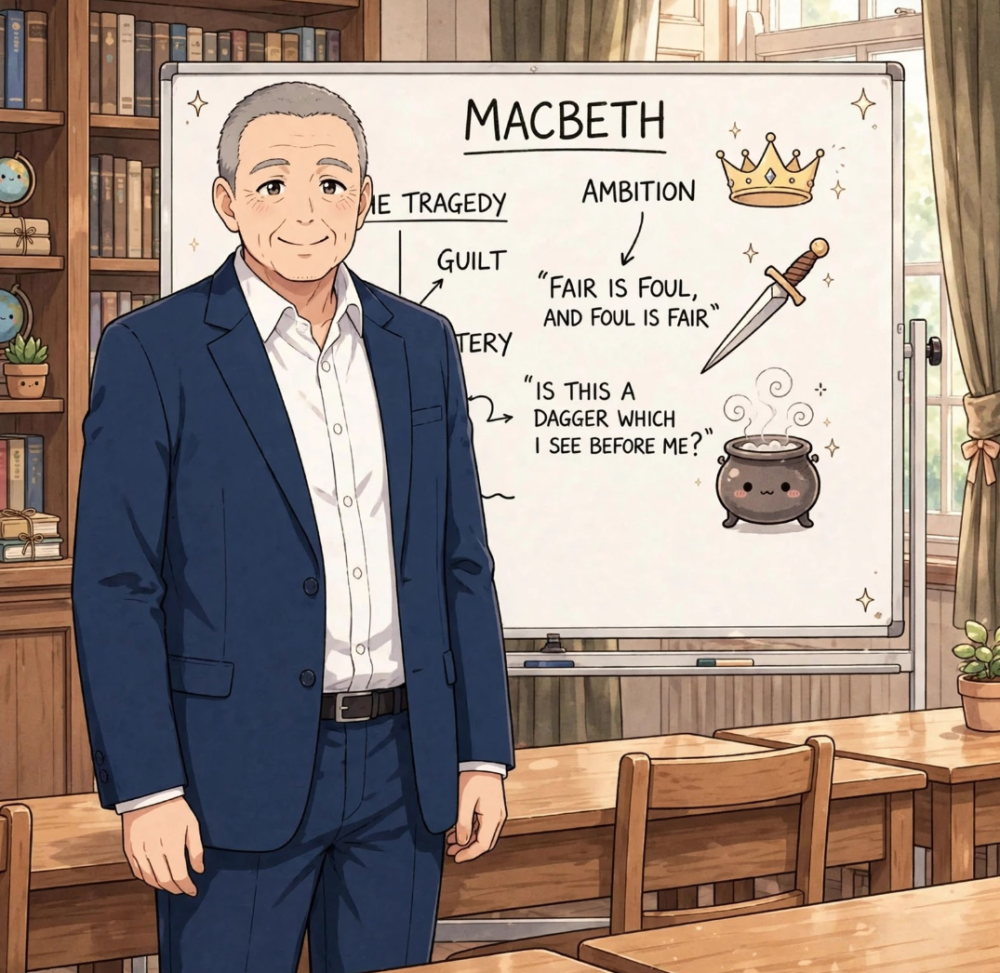
Arguably, the one exam task that gets you from a 4 to a 3 or from a 7 to a 6, or even a 5, is the creative writing task.
Actually, there are two of them… See the below picture and you will recognize something.
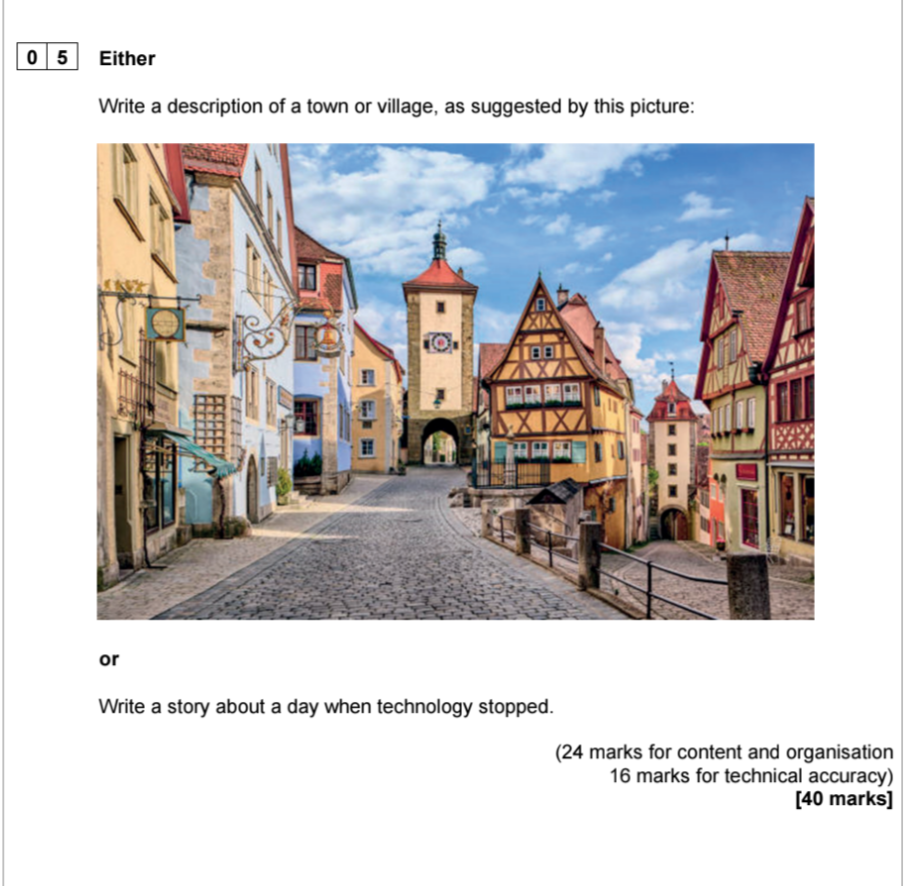
You have done questions 1 through 4 and used all those lovely PEED chains (if in doubt search this site for those) and now, in the remaining time, you have to do this.
Which would you do? A or B?
The first asks you to write a description of a town or village using the picture as a guide. Words like picturesque and all sorts of others come to mind, but it asks for a description, not a story. So many of the students I have taught have made that mistake, starting with something like…
“The town was beautifully ornate…..”
Wrong! I am not being nasty for the sake of it, but those who think that at fifteen and sixteen it is easier to write this one over a story, are very wrong. This is the hardest of the two to do because of one thing and that is that as humans, we are usually so good at telling stories.
So what about task B on the page, the little bit under the picture?
Write a story about a day when technology stopped.
Immediately my lunatic brain is playing with this one. If I was sat there in the exam, my brain would be going technology…….machines……..androids…..Terminator……..
Then all manner of things can take place, but when I first saw this one the other day from a year or so ago on the AQA site, which you can look at by the way, I thought that in the time you have, 600 words is going to be enough for you, but those 600 or so have to be epic in every way.
It is not a bore fest!
Maybe then, use the likes of ChatGPT or Dola to write a few from the titles before now and see.
Here is one based on this task. Note: It is not my writing. I just added the task in and hit ENTER.
It started not with a bang, but with a silence that echoed in the world. At 7:14 a.m. precisely, the world held its breath.
In Wakefield, I was pouring tea when the radio cut out, mid song; no static, just empty air. I reached for my phone to check the time. The screen was black. I tapped it, shook it, pressed the power button until my thumb ached. Nothing. Not even a flicker.
Down the street, a car engine sputtered once, twice and then died. Then another and another, like dominoes falling across the valley.
By the time I stepped outside, the hum of the world had vanished. No distant traffic, no whine of passing jets, no low thrumming of power lines that you don’t notice until it’s gone.
The sky was bright and empty; no contrails, nothing moving above the rooftops. Mrs Henderson from number 42 stood on her doorstep holding a dead hairdryer, looking as if she’d forgotten how to speak.
“It’s all gone,” she said finally, quiet as a prayer. “Every last bit of it.”
It wasn’t just phones or cars. It was everything. Laptops, streetlights, supermarket tills, traffic signals, hospital monitors; the great cooling fans of power stations all stopped at once. Not broken, not blown out, just… still. Batteries held no charge. Circuits went cold. Even watches with digital faces froze at 7:14 a.m., as if time itself had decided to pause.
Confusion turned slowly to bewilderment and then to something sharper. People gathered in small groups, checking devices, shaking heads, speaking in low voices. Someone said it must be a solar flare. Someone else said war. A teenager ran past shouting that the aliens had come. But there were no flashes, no explosions, no shadows in the sky, only light and stillness and the strangest quiet I have ever known.
By mid morning, the true weight of it settled in. The shops stayed shut as there was no way to take a payment and no way to open the doors. The buses didn’t run. Trains stood silent on the tracks, like long lines of steel ghosts stretching north and south.
An old man sat on a bench watching the empty road and said,
“We’ve been using these things so long, we forgot how to live without them.”
He was right too. For a generation raised on screens and signals and instant answers, suddenly we had nothing but each other and then, something shifted. Panic didn’t vanish, but it softened.
The baker wheeled his cart out before noon, cash wouldn’t work, so he handed out loaves and said,
“Pay me later, or don’t; just take what you need.”
People brought what they had: jars of jam, sacks of potatoes from allotments, bags of apples picked from gardens. Neighbours knocked on doors they’d never visited before, checking on the elderly, sharing water from kettles heated over wood fires. Children who would normally have been glued to tablets ran in the streets, but instead, they were kicking balls and chasing each other, their laughter loud and bright and unfiltered.
I walked up to the bridge over the Calder. The river looked brighter than I’d ever seen it: no reflections from phone screens, no glow from shop windows to dim the stars later on. A man I’d never spoken to before stood beside me.
“You realise we haven’t been this truly together in years?” he said. “Always looking down, always somewhere else. Nowhere to go but here.”
Afternoon slipped into the evening softly and slowly. Without electric lights, the sun set and the dark came early but it wasn’t frightening. Candles and lanterns appeared in windows, golden pinpricks strung across the terraces.
People sat on doorsteps and shared stories instead of scrolling through them. They talked about childhoods, old jobs, the places they’d come from. They remembered how to listen. One woman even sang an old hymn from her doorway and down the street another voice joined in, then another, until the whole row hummed in harmony.
No one knew how long it would last. Rumours drifted through the twilight; some said days, some said forever. There was fear, of course, for those who relied on machines to live, for families separated across oceans, for all the things we’d built that now lay still.
But there was gratitude too. Gratitude for the quiet, for the faces turned toward each other instead of down, for the chance to remember what matters most.
Late that night, I sat on the garden wall and looked up. For the first time I could remember, the sky was alive with thousands of stars, sharp and clear, stretching all the way to the horizon. Without the glow of the world’s machines, the universe had come back into view. I thought about all the people doing the same thing, in villages and cities across every continent, looking up, together, in the dark.
I considered how the machines might return tomorrow, or next week, or never. We would rebuild, adapt, find new ways. But I think we all knew something had shifted inside us. We had seen what we were without the noise, not less, but more. More present. More connected. More human.
The world didn’t end that day. It just stopped long enough for us to find our way back to one another.
***
There are approximately 1000 words here which would take some doing were you writing it out in the exam script. Considering the time, expect to have to write 600 words…
RJ September 2026










You must be logged in to post a comment.