Unknown's avatar

About Robert Johnson

English teacher since 1997. Worked in High Schools in Yorkshire till 2005. From 2012 have worked in FE establishments. From January 2015, worked in Adult workplace training delivering Funky Skills Maths and English.

A Child to his Sick Grandfather

A Child to his Sick Grandfather

Grand-dad, they say you’re old and frail,
Your stocked legs begin to fail:
Your knobbed stick (that was my horse)
Can scarce support your bended corse,
While back to wall, you lean so sad,
I’m vexed to see you, dad.

You used to smile and stroke my head,
And tell me how good children did;
But now, I wot not how it be,
You take me seldom on your knee,
Yet ne’ertheless I am right glad,
To sit beside you, dad.

How lank and thin your beard hangs down!
Scant are the white hairs on your crown;
How wan and hollow are your cheeks!
Your brow is rough with crossing breaks;
But yet, for all his strength be fled,
I love my own old dad.

The housewives round their potions brew,
And gossips come to ask for you;
And for your weal each neighbour cares,
And good men kneel, and say their prayers;
And everybody looks so sad,
When you are ailing, dad.

You will not die and leave us then?
Rouse up and be our dad again.
When you are quiet and laid in bed,
We’ll doff our shoes and softly tread;
And when you wake we’ll aye be near
To fill old dad his cheer.

When through the house you shift your stand,
I’ll lead you kindly by the hand;
When dinner’s set I’ll with you bide,
And aye be serving at your side;
And when the weary fire turns blue,
I’ll sit and talk with you.

I have a tale both long and good,
About a partlet and her brood,
And cunning greedy fox that stole
By dead of midnight through a hole,
Which slyly to the hen-roost led –
You love a story, dad?

And then I have a wondrous tale
Of men all clad in coats of mail,
With glittering swords – you nod, I think?
Your fixed eyes begin to wink;
Down on your bosom sinks your head –
You do not hear me, dad.

Joanna Baillie

Analysis

Where does one start with a poem so beautiful and heart wrenching as this?

The obvious place to start is the title. As mentioned before on this site, the title and the poem mostly match in all poems, but sometimes, there are exceptions. This is not one of those exceptions and is as obvious a title as it gets. Think for a minute of a parent or sibling that you love and maybe have lost. Imagine being able to tell them what you think of them even though they are either gone, or at that stage in life where they fail to recognise you anymore through age or illness. Then imagine writing down those thoughts. That is what this poem is, a collection of thoughts on a relationship between father and son. It is a special bond indeed, or at least it should be, so when I see these words, my heart, a usual swinging brick, melts due to several reasons, some of which I am not going to go into here. Suffice to say that I have had my own degree of pain in this relationship but now, all seems well again. For now. I adore my daughter and always will, no matter what anyone else says. So when I see these words, I imagine her, twenty five years from now, when I am a 70 year old, cantankerous old soul, moaning about the world and its woes [I do that now so nothing changes] and her looking at me and remembering the past.

Likewise, I am reminded when I read this of a poem by Seamus Heaney, or Famous Seamus as I know him. I have studied it and taught it and it is called Digging. Give it a read and let it digest before reading and looking at this one. It would not surprise this teacher if AQA or WJEC shoved Digging into the Unseen Poem slot for your exam, given this poem and a few others in this Edexcel anthology.

So, what is this one about? What message is being shared?

The title says it all really. It is aimed at a Grandfather, or “Grand-dad,” who he obviously adores, but his nurses say that he is “old and frail” and that his “stocked legs begin to fail” when he stands. As someone who struggles now with standing at times, due to illness, I know the feeling and can sympathise with this Grandfather, although I am not there yet. He carries a “knobbed stick” when he walks, which is a non-word [or dialectal] that should represent the word “knobbled” or “knobbly” because there are some knots in the wood of it. He then remembers, through use of parenthesis, or brackets, that this at one time, used to be his hobby “horse” when he played with him when he was younger, but now reflects that it “can scarce support [his] bended corse.” By this, because he is so aged, he is bent over, possibly with rheumatism or normal ageing that the body goes through. He has gone from a lean, mean machine of a man to something not good in his eyes. He will feel the pain for him because he is so close to him. Everything he does has to be done with his “back to [the] wall,” where he perches himself, “so sad.” This has such a profound impact to see him this way and he shares this emotion by saying “I’m vexed to see you, dad.” It is as if he is saying it to him directly.

Did you notice that he says “Dad” here? This is done for effect in that he sees this man just like he does his father. Perhaps, he has lost his father and this is one of those moments where you slip up and call someone Dad when it should be Granddad? You now need to find out about the poet and see. Google to the rescue I suppose. If her own father passed when she was in her mid 50s, then this might be the case and the ‘he’ might be her writing in the guise of a man [because of the patriarchal times back then] but if not, then it is something else.

He continues to the Grandfather, telling him directly, even though he may not understand, that he “used to smile and stroke my head and tell me how good children did.” It is as if he is remembering him saying, “in my day it was so different than it is now.” It is a sentence heard by many of us as we grow older and said by so many fathers and Grandfathers. I even see my 55 year old father, in my heart and mind, thirty years ago, saying the same thing to me and I now say it to my 24 year old and 23 year old children. It is a frightening thought that I am turning into my father but there you go. Time has its effects.

“But now,” he says, he “wot not how it be.” This is an old use of language, or what we term an archaism, or a use of archaic language in that it is seldom used any longer. It means he does not want it to be how it is, or maybe even, that he does not understand how it can be, that this lovely Grandfather can get to this stage in life and be so troubled. Archaisms are used by poets to signify age of something, or link a theme of age to someone, as in this case. The man is old so a few archaisms in there have the effect of linking them to the man, in your mind. Or they should do.
 Caucasian-Grandfather-gs-high-res.jpg

This is a time where the man “seldom [takes her] on [his] knee” any more. I remember those times when I was 5 and 6 years old, where my Grandmother taught me the alphabet, whilst I sat on her lap, reciting A through Z and singing it. Then we would do it backwards; Z.Y.X.W.V.U.T etc right back to the beginning. When I then went into a classroom for the first real time, in primary school, I knew them. I remember that with fondness and who knows, my old Grandma may have seen the English teacher in me even then because I sure didn’t. This Grandfather is no different I suppose and this poet is like me, “right glad to sit beside you, dad.” I love to sit with my 86 year old Mum, as adorably dotty as she can be at times, because I adore her so much and will feel the loss, when she passes, like no other I have felt before [or after I suppose]. My love for her transcends all emotions and I see this young man in the poem in the same way with his Grandfather, the one he calls ‘Dad.’

As he looks at him, he ponders on his appearance, adding “how lank and thin your beard hangs down!” Note the use of the exclamation mark here. It signifies that maybe he is not happy with the level of his care, something I see with my own mother. “Scant are the white hairs on your crown” and “how wan and hollow are your cheeks” meet with the same thoughts. He is seeing him deteriorate and cannot take the heartbreak. If you have never read it before, locate Simon Armitage’s poem called “November” and have a read. That has a similar feel to it, even though the context is different. He sees how his “brow is rough with crossing breaks” and sees the strength flowing away from him. Imagine, for a moment, how this feels. I know some of you may be teenagers, but imagine seeing your own parent or carer suffering with something terminal and seeing them wane so quickly. It is a painful sight indeed. I once saw it from the opposite angle, with a Year 8 child I taught in the High School I was in, who had Cancer and an aggressive one at that. Her normal, jovial self vanished in weeks before she died and the effect on us all was catastrophic! Just as much as he sees this, the same feeling emerges from him onto the page, that of adoration and even though “all his strength be fled” he still loves his “own old dad.”

It is such a gorgeous image!

ct-6515-6

Up till now, we know that the man is ailing but now the poem turns a corner and we see just how close to death he is as “the housewives round their potions brew and gossips come to ask for you.” These are visitors who will be seeing him possibly for the last time. “Good men kneel, and say their prayers and everybody looks so sad,” he says, “when you are ailing, dad.” It is as if he is in a death bed somewhere, or near death at home and the neighbours are coming, the fellow believers are saying prayers over him, asking God to heal him, or more likely, help him be at peace and yet, there is a defiance in the heart of the poet, who asks of him, “you will not die and leave us then? Rouse up and be our dad again.” He is asking, or it could be said, praying, that the old times return, for that is normal in these circumstances. We tend to think back to those wonderful times and wish they could be run again. I would give anything to go back a few years to certain points in my life as a father and make the right decisions instead of the wrong ones. But hindsight is such a wonderfully painful jacket to wear isn’t it?

As the verse continues, keeping the rhyme scheme rolling, we see him doing just that; reflecting on former times. He then tells him how “when you are quiet and laid in bed, we’ll doff our shoes and softly tread and when you wake we’ll aye be near to fill old dad his cheer.” Grandfather is sleeping it seems. He is resting, waiting on God and that is a time we all dread. It is a time some fear but there is no need. But as he reflects, he thinks about how it could be all very different if he would but recover from his ailments. He thinks of how, “when through the house you shift your stand, I’ll lead you kindly by the hand” and “when dinner’s set I’ll with you bide and aye be serving at your side.” If only he would recover, he would be able to help him out so much. It is as if he is regretting not doing more in his life when he had the chance and if true, then this is a painful regret he is experiencing because it can never be recovered. It can never be turned back, just like time. It is also something that we all face from time to time. Feelings and emotions therefore, that are being shared centre on love and adoration but also on loss and regret. The pain is palpable as he watches this old man struggling. “When the weary fire turns blue,” he thinks, “I’ll sit and talk with you.” Why is he thinking this now when he had ample opportunity in his earlier life?

Such is life in the way it is nowadays.

He then goes on to mention something else that we get from our Grandparents, or at least I did. I cannot remember which one taught me which one, but the stories I know come from my mother and my Grandmother, so I see the next section of the poem and smile affectionately at the thought of Susan Spencer and think to myself how blessed I am to have had such a woman as this in my life. The poet says “I have a tale both long and good about a partlet [animal] and her brood and cunning greedy fox that stole by dead of midnight through a hole, which slyly to the hen-roost led.” A story of the animal kingdom that was perhaps shared when he was a lot younger is something that would normally come back to him now because she knows that Grandfather loves a good story. He will be the one who taught him that one when he was very young. Sly Mr. Fox etc. The words “you love a story, dad” are so lovely to see. It is as if he wants to retell that story to him right there at that moment to make the pain go away. It is such a lovely thing to behold in this time of woe.

The last verse though, for me, is perhaps, the most painful and the most poignant. He goes on from the last verse into another story he knows well, more than likely one of his again “of men all clad in coats of mail, with glittering swords.” Now, whenever I see stories of yore like this one, in written form or especially in filmic form, I tend to jump and reel and think to myself that some money will have to be spent to go and see it. The newest King Arthur film, with Jude Law has yesterday, had the same effect on me. Now where did I get that love of the Arthurian legend come from I wonder? I can remember the film The Sword In The Stone for years ago, the Disney classic, but I think I was fascinated earlier than that so I can only deduce that at some point, my mother of Grandma told me stories of men in armour and sword fights and the legend of Excalibur, for I simply cannot get enough of it. Imagine my glee when in my degree I got the chance to study the literature in depth.

This Grandfather nods in agreement, or at least he thinks it as his “fixed eyes begin to wink.” Is it a wink, or is it something else? Be prepared to see more than one reason why this is happening in the poem, especially when you link it with the next line, where we see these words: “Down on your bosom sinks your head.” Has he gone to sleep? Has he simply lost control of his neck muscles? Or is his illness taking him to the land of yore, where men in chainmail reside and Kings and Queens send forth Knights on quests to find the Holy Grail? All sorts of possibilities exist within those two lines.

85a84bc11ba30f192128130cde237455

But above all, just as much as the first line links us into the image of the Grandfather, the last line asks us to consider his end as it approaches, either in this instant or in the future for we see the words “you do not hear me, dad” as he looks on, in pain and heartache. Now the fact that the poet uses “Dad” for “Grandfather”  and the hyphenated term of “Grand-dad” at the beginning of the poem makes me ask one thing: when she uses the word “Grand,” is she meaning “Good” or Great?” I ask this of myself because where I am from, if something is “grand” it is considered to be fantastic. If someone asks me what the food is like I have just been served, I may respond with “it’s grand is that!”

joanna-baillie-1

Joanna Baillie was my age [55] when her own father died so this is perhaps her way of remembering him, not only as he was close to death, but also afterwards. It is such a beautiful poem and all the more gorgeous because of the date when it would have been written. In the back of the anthology, you should have dates for that, but my advice is to Google Joanna Baillie and see for yourself where the penchant for storytelling came from and how she was the daughter of a clergyman, which would have given her access to books and literature in bucket loads. Once you have that, you will appreciate this even more.

Nettles – Vernon Scannell

Nettles

My son aged three fell in the nettle bed.
‘Bed’ seemed a curious name for those green spears,
That regiment of spite behind the shed:
It was no place for rest. With sobs and tears
The boy came seeking comfort and I saw
White blisters beaded on his tender skin.
We soothed him till his pain was not so raw.
At last he offered us a watery grin,
And then I took my billhook, honed the blade
And went outside and slashed in fury with it
Till not a nettle in that fierce parade
Stood upright any more. And then I lit
A funeral pyre to burn the fallen dead,
But in two weeks the busy sun and rain
Had called up tall recruits behind the shed:
My son would often feel sharp wounds again.

Vernon Scannell

Analysis

On the surface, this poem is a simple account of how a three year old son comes in from the garden, has been stung by nettles and tells/shows his father, who comforts the little one and then how the father goes out and hacks at the things as if the same thing will not happen next time.

But it is so much more than just that little story.

Vernon Scannell’s poem is a tour de force of how to write poetry, with an easy rhyme scheme and an equally easy tonal quality in it to be able to read it. But it shows us something about the true nature of love, especially when something comes to challenge that love.

As usual, let us begin with the title. One word. Nettles. But when you first see or read or say that word, what is the one thing that pops into your head? For me, it is the memory of that pain and that rash when I was hit by these things as a child, or when I was an adult and gardening and the damn things got me in the join between thumb and hand, that fleshy bit where it hurts like hell and seems never to stop. No amount of water, or salt, or dock leaves seems to ease the pain. So for me, this is a poem more about pain than love, but underlying that is the theme of love that is shown from the child to the father and from the father to the son. It is also a metaphor for the poet’s own pain from his previous experiences in the British Armed Forces, where he saw things and did things that pain him now and play on his mind.

So, first things first; search for information on Vernon Scannell on Google. When you get it, then read this poem, for you will then see things that you would not normally associate with the poem. The first thing I see here is the reference to the son, which is meant to get your support, from the beginning of the poem. “My son aged three,” he says, to make you respond to him positively, “fell in the nettle bed.” Immediately, all those memories of nettle rash as a child come flooding back to us and we empathise, or feel his pain, but do we feel the pain of the father also? As a father myself, I remember when my two children got themselves into scrapes and came to me wailing in pain and abject agony. They were not in that amount of pain of course, but it was just the shock of something attacking them that made them respond.

We used to tell them “get up before it hurts” or some other thing, or make them laugh about it, or something, to take their mind off the issue, which is what the father does here. He then says that the use of the word “‘bed’ seemed a curious name for those green spears” making us think now of real spears that are used in battle. In this case, the spears are used for defence of the plant by the plant, but in times of war in days gone by, they have been more used to kill people or inflict real pain. Couple that military image with the one in the next line, of a “regiment of spite behind the shed” and you immediately see the poet’s preoccupation with the armed forces. When you do your research on him and where he ended up for therapy, you will see this poem in a new light entirely.

This place behind the shed, he says “was no place for rest.” It is a place of pain. It is a war zone. It is a field of battle. It is, in the poet’s mind anyway, a killing field, so he sees his child come to him “with sobs and tears” seeking “comfort” from the pain and he sees those usual “white blisters beaded on his tender skin.” Now, think of the word “tender” in the middle of all those words about pain and you see what he is doing with the language he is using. All the good exists in his son and all the evil exists in the plants. But they need to grow, just like everything else in the world and will not be stopped. He cannot see that or understand that at that point in time.

Father comforts his crying toddler

Now that the child is with him, seeking solace, he as a loving father treats his wounds just as a medic would in a war zone. He soothes his pain till it is “not so raw” and eventually, the child offers him “a watery grin,” which in itself signifies love between him and his father. This is a loving relationship between father and son, a two way, reciprocal relationship based and grounded in love and care. This is something special when this kind of relationship can exist. Believe me when I say this, it is not an easy relationship to perfect, especially when things go wrong.

But then, we move on in the plot line of this mini saga as we see the gentleness of the father turn to hatred and loathing for the plant that has caused so much damage and he takes his “billhook” [look it up] and hones “the blade” till it is incredibly sharp and venomous [just like the nettles themselves] and goes out to slash “in fury” at them “till not a nettle in that fierce parade” stands upright any more. The language used is that of the Army, with words like “blade” and “fury” and “parade” reflecting how they stand to attention in the wind and are incredibly venomous to all that come into contact with them. Likewise, he then burns the dying bits of nettle in a fire but describes it as a “funeral pyre to burn the fallen dead,” who remind him of soldiers in the heat of battle [no pun intended]. In times of warfare, they used to bury their dead en masse or burn them to destroy the bodies. This is a pyre of fallen dead nettles, that if left to rot on the ground would reform shoots and roots and grow back all the more.

Now, at this point, it is natural to think that this is all over, but any keen gardener knows that you can never stop nettles and weeds from sprouting up anywhere they want. When they are pulled up or cut up, their spores are released and drift to the ground and off they go again, blooming later in the year. Check out the story in the Bible about the sower who sows seeds on good ground, stony ground etc. There is a mention of weeds there too but they represent something else entirely.

eat-nettles6

Scannell knows that soon after this event, the things will begin to grow again. He says “in two weeks the busy sun and rain had called up tall recruits behind the shed,” continuing the metaphor and the language from the poem into the future. He says that his son will “often feel sharp wounds again” and that is total truth, for we never learn. They always manage to catch us with their barb and their sting. But when you think about the relationship between the boy and the father you see one of love and a paternal affection that exists between the two. Note it is the father who the child goes to when in pain, not the mother. Again, do your research and find out why.

In the end, this is in the relationships section because of the relationship between father and son, but it is also there because of Scannell’s relationship between himself and the Army. He hated his time in the armed forces and suffered because of it, spending some time in a mental institution, so we have to see this poem, as well as any of his, through those tinted glasses as if we are walking around in his shoes.

lead_960

In the book, To Kill A Mockingbird, the father, Atticus Finch, tells his daughter, Scout, that until you have walked around in someone else’s shoes, you should not judge the way they lead their lives [my paraphrase] so when I see this poem and know about his inner turmoil and pain, I see a man who needs to write about pain and suffering, which he endured. I see a man who sees the pain of his son and is reminded of his own pain and suffering and I see a man suffering with PTSD most likely and having to write his way out of it. As someone who suffers in the same way, it is why I write poetry, as a cathartic response to the pain of life and love. This is why this is such a great poem.

Love’s Dog – Jen Hadfield

Love’s Dog

What I love about love is its diagnosis
What I hate about love is its prognosis

What I hate about love is its me me me
What I love about love is its Eat-me/Drink-me

What I love about love is its petting zoo
What I love about love is its zookeeper – you

What I love about love is its truth serum
What I hate about love is its shrinking potion

What I love about love is its doubloons
What I love about love is its bird-bones

What I hate about love is its boil-wash
What I love about love is its spin-cycle

What I loathe about love is its burnt toast and bonemeal
What I hate about love is its bent cigarette

What I love about love is its pirate
What I hate about love is its sick parrot

Jen Hadfield

Analysis

Let me begin by asking you a question. What are the things you love and what are the things you hate? List them on a piece of paper for notes on this poem before you go into any kind of detail on it. Then, when that is done have a think about how you could add a few words to each. Consider the last line of this poem where it says “what I hate about love is its sick parrot.” If on your list it says “I hate school” you could add to it the words “what I hate about school is its rigid coffin” to represent just how we as teachers make you stick to times and attitudes and “because I said do it” attitudes. Try to do that with each of the loves and hates on your list and you can then make up your own version of this poem. That is what I would do as a writing activity if I was teaching this.

My students now know what is coming. Ha!

But what does this poem say about the poet’s hates and loves? Well, it says a lot about what she likes and does not like but also a lot about her attitude to life. She has a vast knowledge of history and life to be able to find examples for each one of her pet hates and loves. She begins by letting us all know that she loves something. Note please, that the love comes first. One could argue that this is because love is better than hate and that she does this at first, for a reason, or because normal ways of thinking make us think of good before evil, or bad. We tend to think in positive terms before we think in terms of negative, but this poet subverts that later in the poem, as we shall see.

She says “what I love about love is its diagnosis,” which in essence, is a strange one. How can we diagnose love? Love is not a disease after all, unless you are one of those people whose glass is half empty rather than half full.

download

She is saying that what she loves is the way we can say that there is nothing wrong with us, for we are in love. But then she goes for the polar opposite in saying “what I hate about love is its prognosis.” Now, a diagnosis is when we say what is wrong with someone; Cancer, Appendicitis etc. A prognosis is where we say what the outcome should be, where we say to a terminal Cancer patient that they only have six months to live. Now this is where the title, for me, comes into play, because the phrase “Love’s Dog” makes me think of something I learnt from a Facebook friend recently when he said that the “Black Dog” has returned. Knowing he has two cats got me all concerned, so I commented underneath and then he explained that the “Black Dog” phrase was in fact, a metaphor for depression. With that in mind, it is possible to see that “Love’s Dog” may represent the depression that love can bring, when it is going wrong, or when those moments come where we are unable to do or get what we want and feel hemmed in by the fact that we are not single any more.

The poet then says, again in rhyming couplet form, “what I hate about love is its me me me” which is an easy one to consider because there is nothing worse than being so self centred that love suffers. Some folk, in relationships, want it all their own way. They want everything to go their way, be for them, about them, as a result of them. They are so caught up in their own little lives that they fail to think about others. This person hates such people, but what she loves “about love is its Eat-me/Drink-me,” where the relationship is a two way one, where love is equal and fair and equitable. That is love as it should be. That is the message being shared here.

But then we get the words, “what I love about love is its petting zoo” followed closely by “what I love about love is its zookeeper – you.” Again, using a rhyming couplet and sticking to a rhyme scheme helps the reader to be able to read the poem easily enough, but what does it mean? A petting zoo is a place of love, a place where fondness and affection can be shared with animals and each other. That fondness and softness is the thing that the poet is saying should be seen in any loving relationship. But the love she has is for the person on the other end of the relationship. The word “you” is one that can be used to a single person and that is how it is meant here, originally, but it is also a word that can be used collectively as well, where a group of people can have the word used on them. Think of a classroom situation where a teacher says “what I want you to do now is….” and that is where this is being used.

Is this the same here? Can this be used in this way, in any way close to it?

And so the love-in continues with her saying “what I love about love is its truth serum,” which is easy enough to understand; let’s all tell the truth to each other in our relationships. But then she adds, “what I hate about love is its shrinking potion.” Does this sound rather odd in a way? Does it sound confusing? It is not meant to. A lie shrinks the truth in any situation. A lie spoils a relationship. A lie makes it so that only half truths are being shared with our loved ones. Does this make you think of one other poem in your anthology? If so, make a note of that for the exam.

“What I love about love is its doubloons” is perhaps, for me, the best part of this poem. A doubloon, for those that do not know, is a very old form of coin or treasure. We hear all the time of treasure being dug up from old wrecks that contain doubloons and because they are precious metals, they are expensive to buy. This is another example of what she loves about love, how love is precious, how it can be expensive [in money and effort] to keep going but how it is all the more worth it for those who try. But the next line is an odd one to be sure, for when she says “what I love about love is its bird-bones,” we are left to wonder just what she might mean by this. Personally, when I think of bird bones, I think of their strength but also of their frailty, so when I see this line, it makes me ponder on how strong love can be but also how frail it can be. The use of metaphor in this way is so powerful.

Have you noticed the rhyme scheme changing in the poem yet? It is not held throughout the poem. Is this because she ran out of words when trying to make something rhyme with “wash” in this next line, where we are sat there thinking, as poets, about how stuck we are? She states “what I hate about love is its boil-wash” and then couples that with “what I love about love is its spin-cycle.” There is no way to rhyme those lines up but the two lines now link up. One end of the line is about what I know to be a “Number 1 wash” that takes forever to wash. If you start a number 1 off with our washing machine, it is a case of do something else for about two hours and then come back to it as it is just finishing shrinking your clothes. But the spin cycle is something else entirely, at the end of the wash where the clothes are being wrung within an inch of their life and the door is about to open, ready for the clothes to be hung up. With that in mind, consider how she uses it to represent love, in that love can be long and drawn out, something that takes time to master. For her, that is something she hates. This is a person who wants immediate satisfaction in life. She wants the instant tea, instant coffee, instant gratification and love sometimes does not work like that.

DT0033.jpg

As we near the end of the poem, we see these words: “what I loathe about love is its burnt toast and bonemeal” and “what I hate about love is its bent cigarette.” You could argue metaphors are being used throughout, or half metaphor if you like,  because she is not saying “love is” something else but the use of the images of burnt toast, bonemeal and a bent cigarette are powerful images indeed. Burnt toast tastes horrible. Bonemeal, I am sure, will be equally the same. But for me, the image of the bent cigarette is the most powerful for it represents how the male libido [or the woman’s I am sure] can wane with time, or with neglect, making it so that sexual arousal cannot be achieved and when that hits a relationship, there can be issues that come next for any couple.

Finally, we see the last couplet, where a near rhyme is used when we see these words: “what I love about love is its pirate.” A pirate has been portrayed in film and art as a villain but a romance has arisen around the pirate. Think of Captain Jack Sparrow here and think about how the ladies in the stories swoon at him. Yes, they slap him from time to time, but they also love and adore him because he is a mischief at all times, especially with them.

captain-jack-sparrow-captain-jack-sparrow-7791506-500-536

But what happens when that pirate romance turns sour? It leaves us with the idea of love being like a “sick parrot.” A sick bird is a terrible sight indeed, a painful time for the owner, or in the case of love, the partner. When love turns sour, it becomes sick, so you can now see why the poet uses the image.

So, although this is a poem about love within relationships, it is also about the duality of love and hate within that relationship. To some that will sound odd, especially the young. If you love someone, then it will be perfect. That is a rose tinted image of love and relationships, but I can tell you, they are hard work to maintain. The very reason why so many people meet someone, live with them and then break up after 6 months is because they have not got the patience, or the love in the right amounts, to forgive their partner when they do something wrong. Love is kind and generous and giving, yes. But love is also something that makes us want to put the other person first in all things. When we do that, we can love with a purity that will cover any sins [things we do that are bad] that our partners will do wrong. When we learn to love like that, we still will see negative things in our relationships, but we will also see that the love in that relationship is richer because we do not put ourselves first all the time. For me, that is the message of this poem.

Valentine – Carol Ann Duffy

Valentine – Carol Ann Duffy

Not a red rose or a satin heart.

I give you an onion.
It is a moon wrapped in brown paper.
It promises light
like the careful undressing of love.

Here.
It will blind you with tears
like a lover.
It will make your reflection
a wobbling photo of grief.

I am trying to be truthful.

Not a cute card or a kissogram.
I give you an onion.
Its fierce kiss will stay on your lips,
possessive and faithful
as we are,
for as long as we are.

Take it.
Its platinum loops shrink to a wedding ring,
if you like.
Lethal.
Its scent will cling to your fingers,
cling to your knife.

Analysis

Have you ever read something and immediately thought what on earth is happening here? Well, for me, this one is one of those moments. At first reading, knowing Duffy’s penchant for the negative images in life [see Salome] I am led to think she is pulling the idea of love apart, but you never know, she might be being more literal than usual here and making us think in terms of different images just what we expect being in love to be like.

Valentine’s Day is one of those days when we can lose our minds; buying cards, chocolates, roses for someone we admire, or love. It can be for the one closest to us, or it can be just someone we admire from afar who gets those roses or wine. It is a commercial nonsense in reality and I for one choose not to opt into that loss of half my bank account just for that day to be a happy one. If I cannot give my lover a good day on that day or on any other day of the year, then I do not deserve her in my life.

So when I see someone putting pen to paper like this and saying that she would not give out a Valentine, ether in card, or message, or sweeties, then I applaud, especially when I see her bring in the image of the onion.

layers-of-the-onion

She says she would not buy “a red rose or a satin heart” but instead would provide at least one gift, the gift of “an onion.” Now that is a statement indeed. How many of us think ooooh, stinky onion, so therefore she means he stinks? As a lover, or maybe even really, as if she is saying he is useless. That is, if indeed it is referencing a ‘he’ and not a ‘she’ for it is one of those poems that can do both.

She then delights in the torture of adding insult to injury by describing what the onion is and does and makes us think of how these attributes can be given to the person receiving the poem. She says that an onion is “a moon wrapped in brown paper” which is all well and good and hints at the fact that the glories of the moon can only be seen at night. If the same is true of her lover then her lover is not the best one out there. This onion “promises light like the careful undressing of love,” like the layers of love that can be revealed one by one.


Years ago now, my wife and I went to see a play at the Liverpool Playhouse in the UK, with Pete Postlethwaite starring as Scaramouche Jones, a clown who wore seven faces and the idea of the show, a one man acting tour de force as well, was that he had finished his shift and one by one, took off each part of his face; make up, fake nose etc and spoke to the audience to reveal his inmost self. It was a most illuminating experience, seeing him reveal a bit of his humanity step by step. What Duffy is suggesting here is that in this poem, the image of the onion is acting in the same way. It is a vegetable with layers.

A little like Donkey and Shrek, who discuss the self same thing in their adventures, an onion has so many layers and so does love. Could Duffy be saying therefore, that her love for her lover is one that has so many layers and that a mere card or a box of chocolates is so one dimensional that it borders on boredom with a person, or a degree of love that is lacking in the relationship? Perhaps, this might be the case, for there is a chance that what she puts next reveals why she uses such an image in this poem. “Here,” she says, “It will blind you with tears like a lover.” This use of the simile is effective because we are thinking of the onion and how it makes us cry. Love does that doesn’t it? Love is so many good things that makes us rejoice, but love can also make us cry floods of tears when things go wrong.

Duffy adds that “it will make your reflection a wobbling photo of grief,” which is a fantastic image when you think about it. Love has the power to make us think we are one thing when we are not and when we look in the mirror, hopefully seeing the truth of what lies there before us, what we see when love fails is a jibbering mess, a wobbling strawberry jelly with blancmange on top that is unsteady, unsure of itself and wobbling all over the place. Love, therefore, to Duffy, is a lie. Duffy then inserts something that is almost a disclaimer for she says “I am trying to be truthful.” Is this a point where she says hang on, I am being honest here. I am laying my heart on the line. This is why I do not go in for all this Valentine’s Day rubbish? If so, then she is making the reader, who by now is either smirking or laughing their butt off at the image of the stinky onion, rethink immediately because she is bringing them [and us] back round to sensible normal thinking by saying she is not messing about.

“Not a cute card or a kissogram,” she adds, as if almost to add an extra thought. None of that nonsense will come from her. This lady is past all that rubbish; sentimentality gone wrong in her opinion. No, this will not be her way, both now or in the future. This is a woman who is intent on stepping outside the boundaries of the normal existence and understanding of love and someone who likes to do things her way. “I give you an onion,” she adds, because “its fierce kiss will stay on your lips, possessive and faithful
as we are, for as long as we are.” It is a great image, the one of the onion [or the kiss] being something that lasts on the lips of the recipient. When we have onions, if we add them to a cheese sandwich and they are raw, boy can they make our mouths stink. I love them, personally, but they do have that tendency to affect our breath after we have had them. So too, she says, does love linger on us, like a kiss that will never be forgotten.

“Take it” she says, as if the receiver needs second bidding. A kiss is a kiss. It is something between two people that when right, when done right, is utterly glorious and enticing. But Duffy is saying that this onion now represents the love that she has for her lover, in the form of an onion whose “platinum loops shrink to a wedding ring” as it gets closer to the centre and in whose hands, if handled wrongly, can be “lethal” enough to cause the utmost damage. Love is patient and kind, as the saying goes, but love can also be nasty and brutish and short. If you want to know what I mean, look up the poem Caritas Est, on this website. It will make you rethink your thoughts on love and was written by a fourteen year old!

An onion has an odour that is unmistakable and “its scent will cling to your fingers” as much as “cling to your knife” when you wield it, so what Duffy is doing is saying that she loves her lover, and she does so with an honesty of love that is pure and innocent, but realistic as well. She does not need the garbage that is farmed onto us all every January in the shops to show her lover her love. No. Garbage like that is pointless, she is saying and should be avoided, for love is the most glorious thing in the world and it should never be mishandled.

One Flesh – E Jennings – An Alternative Analysis

One Flesh – Elizabeth Jennings

Lying apart now, each in a separate bed,
He with a book, keeping the light on late,
She like a girl dreaming of childhood,
All men elsewhere – it is as if they wait
Some new event: the book he holds unread,
Her eyes fixed on the shadows overhead.

Tossed up like flotsam from a former passion,
How cool they lie. They hardly ever touch,
Or if they do, it is like a confession
Of having little feeling – or too much.
Chastity faces them, a destination
For which their whole lives were a preparation.

Strangely apart, yet strangely close together,
Silence between them like a thread to hold
And not wind in. And time itself’s a feather
Touching them gently. Do they know they’re old,
These two who are my father and my mother
Whose fire from which I came, has now grown cold?

Analysis

There are times in every relationship when couples grow apart, some being caused by coldness and hatred and others by distance in the relationship. To the people in the relationship, it can appear as if they are ‘coasting’ in their relationship. They love each other dearly but thirty years of being together, or more if older than me, can cause a couple to live and love together, without there being a need for intimate contact. Likewise, the lack of intimate contact in a relationship is not always a signal that the love is dying, but that is the usual conclusion when you are observing someone else, like a daughter looking on at her parents and coming to the wrong, or false, conclusion.

That is what I think is happening here and my reason for thinking it rests on one line of verse. Let’s have a look, line by line and see what I mean. The poem begins with the words “lying apart now,” which immediately denotes separation between the two. Couple that with them both being “each in a separate bed” and the reader takes the opinion that the love has waned or died and now they are just staying together because of relationship rather than love, a companionship if you like, in old age.

article-1173803-04b01512000005dc-602_468x354

How far from the truth could we be?

The picture is painted for the reader of them both in the bedroom, “he with a book, keeping the light on late” and “she like a girl dreaming of childhood.” The idea of opposites are obvious but these are the obvious things that the speaker, the daughter, expects to see. They are the things she, at a younger age, sees on the television, but they are caricatures of real life, not their representative reality. The speaker then says “all men elsewhere – it is as if they wait some new event.” This is quite a hurting, callous thing to say, reflecting more of the poet’s opinions of love and relationship than her parents’ attitude to it. It is a reflection of her modern, post feminist attitudes that comply with the likes of Political Correctness than a true look at reality.

The poet then says of the man that his existence is meaningless and uses the image of “the book he holds unread” to bolster her opinion of what is happening. She seems to think that with “her eyes fixed on the shadows overhead” there is a growing distance between them both. She might be right too but I see and offer an alternative here for you to consider. They are described by their poet daughter as resembling something of “flotsam” tossed up “from a former passion.” Flotsam may need to be Googled by you [you have to do some work you know] but she says “how cool they lie” as if all the passion has died. Couple this with “they hardly ever touch” and “if they do, it is like a confession of having little feeling” and you get the common reading of this poem; separation and loss of passion leading eventually, to real time separation and divorce.

However, if “chastity faces them” then this means they intend to stay together, denoting a long, abiding affection for each other, because what else is there? There is no hint of another woman, or man, in the poem. There is no hint of an affair. So the poet is assuming that they will lead “their whole lives [as] a preparation” for something that is coming. Now this is where my proof comes in for they are described as being “strangely apart, yet strangely close together,” a selection of words that sound slightly oxymoronic, if not ironic, seeking to make the reader think it is all but over now for them but in reality, hiding the truth, or offering a half truth if you like.

Does it sound like another poem you have studied now?

There is a “silence between them” and it is this silence that makes me wonder if this relationship is stronger than the poet thinks. She has just got through saying that they are “strangely apart, yet strangely close together,” which makes me think the poet might be missing something. Yes, there is a sense of separation, but real loss is something these two do not share. The pain of such loss brings a couple together. If they had lost a child, they would be in each other’s arms. I know, because I have been there and got that tee shirt.

So why would a happily married couple defer to single beds then? Have a read of this article. It is not as obvious, or an unused thing in modern life as we think.

http://www.dailymail.co.uk/femail/article-1173803/Separate-beds-28-Why-loving-couple-want-sleep-apart.html

The truth of the matter is that there is not enough information in the poem to suggest this is all over for this couple. The words that follow also back up my theory about this poem in that they suggest that the couple are ageing well together, that “time itself’s a feather touching them gently,” making their life together happy in their final years together even if there is a separateness.

Now, there is the traditional reading of this poem and then there are the rogue ones like this, but I ask the same question as the poet, namely “do they know they’re old?” if they have been together for four decades, as is suggested here by the poet [or some other lengthy period of time] then a sense of oneness is formed. The title here, supports my theory because it comes from the book of Genesis in the Bible, where the phrase “one flesh” is used to signify how when two people get married, two become one in union with each other.

Genesis 2 v 24 says, “that is why a man leaves his father and mother and is united to his wife, and they become one flesh.” These two seem to have a real grasp on the meaning of this in their relationship? These two are the father and my mother of the poet, so she is close in the family but she fails to see where their fire and passion comes from. She says that the “fire from which I came, has now grown cold” in the two of them, but this is only an opinion and one that shares her own discontent for love in general. It may be that she has radical views on love and is therefore expressing those views on us, the reader.

Is the love and passion growing cold for this couple? It may well be, but be careful not to consider other alternative ways to read a poem like this.

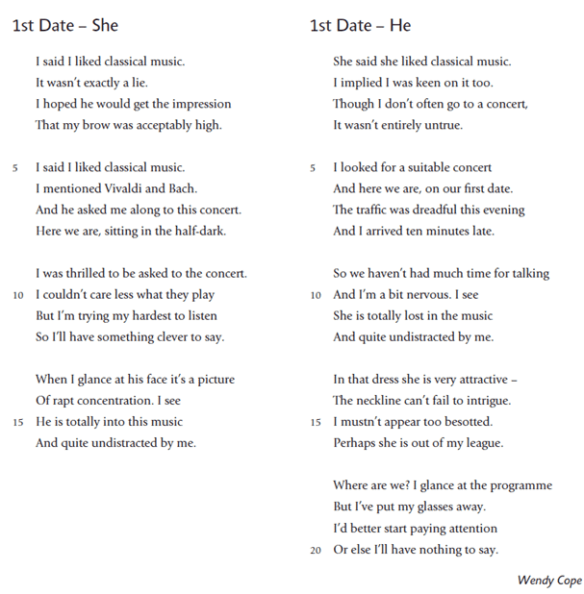
1st Date – She, 1st Date – He

screenshot-2017-02-16-at-21-36-56

Analysis

1st-date.png

The thing I love about poetry is the way it can mess around with words. I heard a James Blunt song this morning on the news, a new one, with this line in it: “I could say you’re beautiful” and then he added the words, “but I’ve used that line before….” This is what I adore about poetry. He is famous for a song called “You’re Beautiful” and yet, he can play with language and add it into something else with irony. With this poem by Wendy Cope, I just love the way that she looks at a first date relationship and twists it.

But be careful, for I am analysing it as it appears in the Edexcel anthology, recently handed out to school children for their study, where 1st Date is on the left hand side of the page and 2nd Date is on the right. But I have had a discussion recently with a teacher who states that the poet, Wendy Cope, did not originally write it like that and there was a different format to the poem. But would this change the meaning of the poem in any way? I tend to think not,  for they are both giving their analysis of the date and how it went on the night.

How you take to this poem then, may depend on the version you have in front of you. Don’t shoot this messenger just because he sees it in the anthology at GCSE in a High School.

Now, think on, have you ever been on a first date? Chances are, you have. Chances are that you know all about the truth that you tell on those occasions. Not! You are so busy trying to please the other person that you show off, or make a fool of yourself and this is what is happening in this poem too, for the both of them are only telling each other half truths before and during their date. It is a thought process, almost like a stream of consciousness writing, but different to that and for you older students, the more mature among us, like me, if you are of a certain age, then you will know of a song sang by Maurice Chevalier, in the film Gigi, where he meets with a former lady he wooed and they discuss, in song, their first date. One says he wore one colour and the other picks him up as if to say “no you didn’t.”

This one reminds me of that encounter from the off because it can be read in more than one way. When you read it for the first time, I am betting that you read verse 1 of her and then verse 2 of hers and then verse 3 and 4 of hers and then you have a crack at his, but try this. Read it verse 1 hers and then verse 1 his. Then verse 2 hers and verse 2 his and so on, down the page. It suddenly sounds like a dialogue between them but of thought. So what is each one thinking? Two voices thinking things of themselves and of their new partner, but neither of them are telling the truth.

From her perspective, she says in verse one that she likes classical music, but that “wasn’t exactly a lie,” but if it was not really a lie then what was it? “Not exactly” does suggest only half right, or a half truth and she says it because she hopes “he would get the impression” that she is rather ‘high brow,’ or posh, to use the vernacular. His response, if we read it like I said, is that he “implied” he was “keen on it too” so as to make her interested in him, but once again, the word “implied” denotes that it is hinted at, but not necessarily is the truth as we know it. He says he does not “often go to a concert” so he is no keen classical music fan and then states that his hint is not “exactly true.”

Some first date this is turning out to be!

So then we have her saying she likes “Vivaldi and Bach,” two world famous composers, but we get the impression they could not tell Bach from a Bath between them both. She says that they are there now, at the concert, “sitting there in the half dark,” which is metaphorical in a way in that whilst someone can be sat in the shade, so in the half dark, it can also represent their relationship in that there is only half the amount of light, or truth, that there should be in their relationship. This date is not progressing well.

His response is to say that he “looked for a suitable concert” or somewhere he could take someone with such an air about her. She is posh, or so he thinks and the clues are in her dress sense. He then tells us that this is their “first date” and that he arrived “ten minutes late.” Now, what does that tell you? He arrived ten minutes after her, so they did not make their way there together. Is he bothered about this date, or has he got other thoughts on his mind? A huge hint is coming later regarding his intentions.

She says she is “thrilled to be asked to the concert.” Whilst this may be true, there is still a sense of an undercurrent of lies as she “couldn’t care less what they play.” It makes the reader think she is not there for the music. What she is there for is the chance to be with him and then be able to talk about it all afterwards. So she thinks that she “better start paying attention.” She needs to do this so as to be able to discuss the concert later, thinking, wrongly, that he will want to discuss it later too. One thinks the other is the fan, and vice versa. Could this be a first date and a blind date?

He, for example, tells us that when he glances at her face, “it’s a picture of rapt concentration.” Yes it is, because she is having to concentrate and find something she can talk about later. He believes that the young woman is “quite undistracted by him.” It is as if the concert has her whole attention but he cannot see the truth; she is out of her depth in all of this and needs to go to the pictures instead.

“So,” says the man, “we haven’t had much time for talking.” Not surprising really when you think about it for they simply do not communicate with each other from the start of their relationship. There is a real sense of separation in their relationship, a sense where they do not feel like they can commit to one another fully, possibly because each has been hurt in love before this moment. 

The most telling part of his part of the poem comes when he says that there seems to be no time for chit chat. Well he is ten minutes late. There seems to have been no chance for him to take her for a drink beforehand and chat her up. He was late and now he feels the guilt of that and thinks things about her that are not necessarily true. He says that “she is totally lost in the music,” which she has hinted at before now, so both are misreading each other. He believes, as she does, that the other person is “quite undistracted by me,” which shows his lack of understanding of the situation.

Then, he tells us that he likes how she looks because “in that dress she is very attractive,” which understates his thoughts about how his date will go in the end, hinting at the hope of a sexual encounter, and follows this up with “the neckline can’t fail to intrigue.” He is looking at this vision of beauty and wanting her to be his, but he is only prepared to go half way into the relationship. Is he dating her just for a sexual encounter, a possible one night stand? Who knows. Possibly.

But he feels that he should not show his true emotions, because that will let the cat out of the bag, but mainly because he thinks that she is in another class of woman entirely. His comment about how “she is out of my league” shows a degree of lack of confidence and also his infatuation with her. She thinks the same thing about him which is interesting, so perhaps the both of them need to be more open and honest with each other for their relationship to flourish.

At this point in their first date, when all should be going well, we then see the extra verse of thought from him, assuming we have read as I suggested, that could be read as an afterthought almost, one of those throw away after comments we make in life. He asks “where are we?” Normally this would hint at the idea that someone is lost, in themselves, or in something else, or that they have not got a clue what is happening around them. This is an example of the latter.

The fact of the matter is that he has put his glasses away. Now when I was teaching this poem recently, I stopped and asked the question I am now going to ask of you: for what reason do you take your glasses off? When I have my photo taken, off come the glasses. Women in films dressed as secretaries with high held hair, drop their hair and remove their glasses. But above all, we drop the specs because we are self conscious and think we look better without them. He then thinks he had “better start paying attention” to her and to the music, “or else {he will} have nothing to say.”

What Wendy Cope has done here is provide a poem that shows a relationship that starts with half truths, a lie if you like, a relationship that exists “in the half dark” of a concert and a relationship that is doomed to failure. Now with that in mind, as you prepare for the exams, which poem can this be linked to in your anthology, so you could compare the two? As you figure that out, then have a go at writing a 600 word comparison of the two. In the exam, you will no doubt see a question that says compare 1st Date … with another poem of your choice, …. and then it will ask you to look at a central theme, such as love, relationship breakdown or silence.

Enjoy!

To Compare and Contrast – In Literature – That Is The Question

To Compare and Contrast – In Literature – That Is The Question

There are many ways to write about someone or something in a piece of literature, whether it be a poem or a play or a novel. The following details two different ways to write this kind of answer. The first is a merging of ideas and is the harder of the two. The second is a more straightforward approach looking at one and then the other. We will call them Plan A and Plan B. Read them and discuss their differences, both good and bad.

Plan A

Magwitch is a diverse character with several different emotions. As a convict, he can act in a violent manner towards the young Pip, but as an ageing man, returning to England, he can take pride in his creation when he says, “I made me a gentleman.” Pip, on the other hand, is a character drawn rather two dimensionally by Dickens, who wants the reader to see Pip as the young man and Pip as the boy in similar ways. His growth from the forge to the city is in one sense irrelevant as the reader sees the growth in the light of his mysterious benefactor. On the other hand, it is Magwitch that appears to be the more historically accurate of the two, due to the use of transportation in the Victorian era. The character of Pip is more of a caricature of the young city gent, several images merged into one to create him.

Plan B

Magwitch is a diverse character with several different emotions. As a convict, he can act in a violent manner towards the young Pip, but as an ageing man, returning to England, he can take pride in his creation when he says, “I made me a gentleman.” Indeed, it is Magwitch that appears to be the more historically accurate of the two, due to the use of transportation in the Victorian era. Pip, on the other hand, is a character drawn rather two dimensionally by Dickens, who wants the reader to see Pip as the young man and Pip as the boy in similar ways. His growth from the forge to the city is in one sense irrelevant as the reader sees the growth in the light of his mysterious benefactor. The character of Pip is more of a caricature of the young city gent, several images merged into one to create him.

Now, which one would get an A* grade, or a 9 in modern money?

You decide and do, because at the end of the day when the exam comes around, you will need to be able to feel comfortable in which way you plan to write. If by taking Plan A as an option, you feel you can sustain the swapping and changing sufficiently well, then it will score very high, so long as the answer is detailed and accurate [as well as written clearly and paragraphed well. I have only offered one short paragraph here, so imagine it two or three pages in length as an answer. If, however, you feel that Plan B is more your preferred way, then adopt it from now through all your training so that you can get used to the style of writing needed for successful writing in this style.

Above all, choose the one that you enjoy writing in the most.

Caritas Est….

A Year 10 student was asked to write an acrostic poem. His teacher gave it as a homework. No guide lines were set, so like most students, he thought “go minimalist” and just write a word for each letter of the word RELATIONSHIPS, but his home tutor [me] shook his head and waved his finger at that idea and so, helped him to understand things like enjambement, free verse poetry, as well as other stylistic devices which can all be found in his poem, below. How many can you locate?

Caritas Est…

screenshot-2017-02-06-at-22-15-27

Real love should be for
Eternity. It should be something that
Lasts and lives on in the heart as we
Adore each other. Real love happens when you
Treat your partner with respect for them
Ingenuity and uniqueness; their loving
Openness. Real love is like a sense of
Nothingness that exists. But, love can also bescreenshot-2017-02-06-at-22-15-19

Sinister, cynical and scary, something that
Hides in plain sight and seeks out its vulnerable pray as
It prepares to pounce! Real love can cause
Pain, forcing you into darkness and causing your
Stability to break down. Real love is hell!
[MK January 2017]

He created this with the only idea from me being that love can be many things and relationships are complex, sometimes showing good and bad in us all. Love is never perfect, so I hinted at him to put the “But” in the middle, but apart from that, it is all his work and I am so proud of him.

Fancy writing a poem about the theme that you are studying in your anthology?

Have a go and send it to me on my Facebook page. The best ones get Amazon vouchers.

Deadline = Last day of February 2017

Sonnet 43 – Elizabeth Barrett Browning

Sonnet 43

How do I love thee? Let me count the ways.
I love thee to the depth and breadth and height
My soul can reach, when feeling out of sight
For the ends of being and ideal grace.
I love thee to the level of every day’s
Most quiet need, by sun and candlelight.
I love thee freely, as men strive for right.
I love thee purely, as they turn from praise.
I love thee with the passion put to use
In my old griefs, and with my childhood’s faith.
I love thee with a love I seemed to lose
With my lost saints. I love thee with the breath,
Smiles, tears, of all my life; and, if God choose,
I shall but love thee better after death.

Analysis

The first thing you need to take into account when reading a poem like this is the life of the poet herself. She wrote poetry from the age of six, at fifteen suffered illness that caused her to live in pain for the rest of her life and took Laudanum from an early age for the pain. This will have affected how she lived her life and her attitudes to life, other people and love itself. She campaigned against slavery, wrote extensively and upon the death of William Wordsworth, was considered for the next Poet Laureate.

She met and was courted by the writer Robert Browning [My Last Duchess] in secret and married him knowing that her father would disown her and disinherit her, so she married for love only, a love that lasts, a love that is eternal. They lived in Florence where she died and her poems were published in various guises, but she is most famously known for this poem, Sonnet 43.

Now, a sonnet, for those who need to know, is a poem of 14 lines, but there is usually a certain writing style used. Ten syllables for most of the lines and fourteen lines makes for a style that is difficult to write, using iambic pentameter as well as all the usual writing literary devices [rhyme, simile, metaphor etc]. Iambic pentameter is a line of verse with five metrical feet, each consisting of one short (or unstressed) syllable followed by one long (or stressed) syllable, for example “Two households, both alike in dignity.”

With that in mind, what becomes obvious is that this poem is written, presumably from her to her husband, or from one person to the next, who is totally in love with the recipient of the poem. Using the sonnet, a tool used widely by writers like Shakespeare, she lets him know just how much sha cares when she utters those now famous first words of, How do I love thee? Let me count the ways.” Starting with a rhetorical question is a very good way to start. It is a question that does not require an answer and is the sort of technique used to make the reader or recipient think about the writer’s love for them.

Then, she answers the question, saying I love thee to the depth and breadth and height my soul can reach, when feeling out of sight for the ends of being and ideal grace.” The use of words like “thee” is an example of an archaism, which is the use of a word that is considered outdated, or archaic, ancient if you like, the sort of word no longer used. Nowadays, the only time we would say this word is in the Lord’s Prayer, when said, or a hymn, when sung. All you need to do is translate each “thee” and “thou” before you try to unpack the poem, so you have it translated into modern English. When you do that, it makes better sense.

She loves this man from the top to the bottom of her soul. Her heart bursts with love and pride when she thinks of him. This is someone she has given up everything for. Her family have said no to her marrying this man and she has married him anyway. So when she says “I love thee to the level of every day’s most quiet need, by sun and candle-light,” she is expressing a romantic love that to her, is total in its extreme, the sort of love we only can dream of at times. This is a man who means everything to her. He is her picture of the perfect man.

But her love is not fake or contrived. It is a real love, a perfect love, a true love; the romantic ideal if you like. She says “I love thee freely” suggesting that the only freedom she knows is with this man. She was never free when with her family for she was never free to marry the man of her dreams. By leaving that behind, she can now be herself, which in terms of when she was alive, when Victorian values were predominant, is a rather bold move to make.

She stresses the perfection in their relationship when she says “I love thee purely” and “with the passion put to use in my old griefs, and with my childhood’s faith.” Now this is interesting, because in our childhood, we tend to think of what we will be and do when we grow up. Socialisation makes it so that women were brought up to think they will develop, meet someone nice, fall in love and get married, with lots of children following in their wake. So for her to say she loves him with the same kind of faith she had when she was a child is a bold statement indeed.

Then, the next verse adds more detail to her depiction of her love for the man when she says “I love thee with a love I seemed to lose with my lost saints.” The notion of lost saints refers partly to those we lose in life so when we lose friends or family, we tend to see them in a more positive manner than perhaps they deserve. I can think of folk who have passed who were not so wholesome in their life, but now when I think of them, I do so with rose tinted glasses on, preferring to remember the best f them, rather than the worst. Love for family will do this to a person, but love for a man [or woman] next to you in life is different, so she is saying that her love covers many different ways of loving.

The final comment she makes finishes the poem beautifully and perhaps shows why readers put this up there as one of the best love poems ever written, for when she says “I love thee with the breath, smiles, tears, of all my life; and, if God choose, I shall but love thee better after death,” what she is saying is that in life she feels as if she has found the epitome of man, someone who she can love with everything in her and even when death separates them, either when she dies or when he dies, that love will continue.

I tend to see my love for my wife in the same way. Our families did not like it when we married. They all said it would be a six month relationship, that it was a phase, that he has only married her because he has got her pregnant; all the usual complaints thrown at a couple who want to lead their lives in the way that they want. But our love for each other is perfect, just like that of the Brownings and it is the sort that has through thick and thin, allowed us to remain married over thirty years later. Why is this the case? We jokingly says we stay together out “of spite,” but the truth is that our love makes us think of the other first in all things. When that happens, you get a relationship where you put someone else above yourself, where you think about the partner before you, where your love makes it so that you never wish to hurt the other.

Now that, for me, is a real kind of love and to me, it is the sort of love that Browning is trying to depict here in this poem. She does it by exploring the boundaries of love, but she knows her bible also, for she knows that in 1 Corinthians 13 there is a description of love that perhaps will help you consider just how much you love that special person in your life.

1 Corinthians 13 vv 4 – 8 says this:

4 Love is patient, love is kind. It does not envy, it does not boast, it is not proud. 5 It does not dishonor others, it is not self-seeking, it is not easily angered, it keeps no record of wrongs. 6 Love does not delight in evil but rejoices with the truth. 7 It always protects, always trusts, always hopes, always perseveres. 8 Love never fails.”

What Browning is saying is that when we approach love for someone else in this light, we do so making it impossible to be self centred, or impossible to not put the loved one first. In this way, her love for her husband is the sort of love that poets and people have always dreamed of; the kind of love that never fails!

Poetry: Student Exam Style Question

I asked a student I teach recently to write about two conflict poems, to show him how to write about poetry. I put before him two poems; The Man He Killed, by Thomas Hardy and There’s A Certain Slant Of Light, by Emily Dickinson. Not the easiest of poems to write about but he had to write about the Hardy poem and then the other, as if he had chosen to write about it, because the task set is like previous exam questions. The theme is conflict.

Here is the title/task he was set and below that is his response.

Writing about The Man He Killed, plus one poem of your choice, show how conflict is portrayed in each poem.

Conflict is portrayed as physical in ‘The Man He Killed’ but is also portrayed as mental in ‘There’s A Certain Slant Of Light.’

In ‘The Man He Killed,’ conflict is portrayed as physical violence. The quote ‘I shot at him’ is a prime example of this as it gives us the impression that the character has orders to shoot his enemy on sight. This makes us believe that the military is savage and dangerous. The fact that the poem was written at the time of the second Boer War, which was a war between the British Empire and the South African republic who were fighting alongside the Orange Free State, leads us to believe it had a large influence on Thomas Hardy’s writing.

However, the poem also shows us how conflict changes the way people act. Hardy states how ‘quaint and curious war is’ and ‘you shoot a fellow down you’d treat, if met where any bar is,’ implying that the infantry were ordered to shoot their enemy on sight even though if they were at a bar they would buy each other a drink in peace time.   

The poem ‘There’s A Certain Slant Of Light’ portrays conflict in a psychological way, as if it is all happening in the head. The quote ‘heavenly hurt’ suggests that the person’s head could be hurting from all the conflicting thoughts. ‘Imperial affliction’ implies that the person has a disease of some kind, like schizophrenia, that affects the way they think or they could have a split personality that is causing them pain.

However, at the end of the poem there is a change of perspective with the statement ‘on the look of death.’ This quote makes you rethink the entire poem and makes you realise that the poem is all about someone’s internal conflict with death which explains ‘slant of light’ and ‘cathedral tunes’ and reflects the belief of an angel taking your soul up to heaven when you die.

The two poems have similar rhyme schemes with ‘The Man He Killed’ having an abab rhyme scheme and ‘There’s A Certain Slant Of Light’ having an abcb rhyme scheme throughout. The use of a rhyme scheme keeps the rhythm of both poems moving. Another similarity is that both poems use four line stanzas. This keeps the poems from becoming bland and makes the poems easier to understand. In addition to this, both poems are about conflict; however, they are about different types of conflict. ‘There’s A Certain Slant Of Light’ is about the conflict in someone’s head whereas ‘The Man He Killed is about physical conflict and what physical conflict can make you do.

To conclude, ‘There’s A Certain Slant Of Light’ and ‘The Man He Killed’ portray conflict in very different ways although it is portrayed the same in some ways, for example, in how it can hurt people.

***

I think this is an excellent first response and with his permission, I am sharing it here. Well done that man.