
So here we go again. June is nearly upon us, here come the Lit exams and then the Language ones, beginning on June 5th I believe. Now that is not long to go.
Paper 1 and Paper 2 of the Language Papers cover 80 marks each so “let’s do the Math,” as the Americans love to say. 2 forty minute sittings where 2 things are written can lose you the best part of 80 marks if they are not handled correctly. That’s the difference between a 9 and a 4 most likely. The whole concept is utterly terrifying!
Section A of each exam is 4 or 5 tasks tasks long. AQA and the likes can change one task into two parts. It has been done before. That is worth 40 marks for all that. Then you get a single thing to write for 45 minutes or so and on Paper 1, there is usually a picture to use as a springboard for your ideas, which is why we teacher loons use spring boarding techniques from Year 7. Ever wondered why you read the last chapter of Skellig and the teacher hated it so he asked you to write your own final chapter, for display?

My lot did just that once!
But the 2nd task asked for, should you choose it, is not a description, but a descriptive account of something happening. How easy is that?
For a lot of you, you will see it and think Oh My God! How do I do that? Your teacher should have practiced this with you and if they haven’t then have a gripe at them, but assuming they have, you should be able to do what I am about to ask you to do.
Task
Read through the following story (written by me and taking 45 minutes to type up) which uses a TV programme as a springboard (see previous post about BBC Ghosts) and make a list of as many things you notice in it.
Eg. (1) Start far left) (2) Indent next paragraph. (3) Speech on its own line….and so on as you go. There are a good dozen things in this account/story that you could say “if this is how it is done, then this is how I have to do it in the exam.”
And that, you see, is the whole point.
Read and create the list as you go.
Happy hunting.
Survival Issues
Frances Eleanor Button was once again walking around the gardens of her home after just spending some time in the graveyard she had made for her pets when she silently came across Mike and Alison in the garden, preparing the ground for their seasonal vegetable planting.
This was her usual daily walk, as she admired the beauty of God’s nature around her in such glorious grounds as Button House. As she saw them both, she came to a stop and introduced herself.
“Ahem,” she muttered, “Good afternoon Alison.”
“Oh, hello Fanny,” replied Alison, but before she could continue, Fanny continued.
“I remember when we had gardeners do such things as this. We used to grow lots of vegetables that were eaten in the house. They were hard times for all of us.”
“They are now, as the energy prices and food prices have just gone through the roof. We thought….”
Fanny had a habit of interrupting anyone as she still saw herself as the Lady of the House. She was about to do just that when Alison gave her a look as if to ask her to stop. Mike just looked up from his onion rows and knew they would be in conversation for some time. As he carried on, Alison changed tack.
“Actually Fanny, there was something I meant to ask you after our conversation the other day.”
“Oh, which conversation was that?”
“The one where you mentioned the trip on the Titanic. I meant to ask…”
“Oh, that!” replied Fanny, before Alison could finish. I would rather forget about all of that if you don’t mind.”
“Yeah, I know, but I had an idea I wanted to talk to you about.”
By this time, Fanny was intrigued at what would come next, so the two of them agreed to go and sit on the garden bench nearby, so they could talk. When they got there, they both took a seat and Fanny waited, which for her, was not the normal thing she would do. Her bombasticity would usually mean she dictated the pace in conversations.
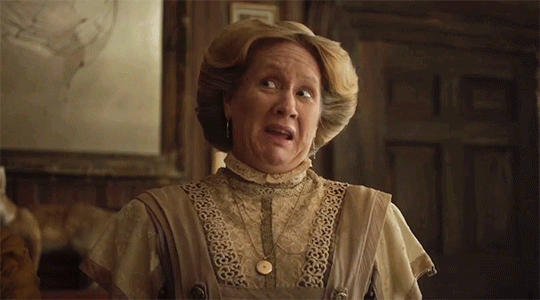
“Well, “ said Alison, “the thing is……” She was thinking of how to word it, because it was a delicate subject. Then she had the idea.
“I wondered if you felt anything at all about not going on that journey.” she watched as Fanny exploded like a small and badly placed bomb.
“Not going? I was glad not to go when I found out the truth of the whole sordid…” She was beginning to get agitated, so it was Alison’s chance to interrupt.
“I didn’t mean to hurt you Fanny,” said Alison. “It’s just that sometimes, people feel guilty about such things as this; things out of their control. Modern psychologists call it ‘Survivor’s Guilt, because had you been on the journey….” She paused, waiting for Fanny to catch up.
Fanny just stared at Alison, making contortions with her face as she tried to sort this news in her busy mind. It seemed, to her anyway, that the longer and older she got, even in death, the more difficult it became to understand such things and the more intransigent she became.
Alison continued.
“If you want to discuss it, you know where I am,” she uttered and gave Fanny a look that meant a hug was intended but could never be given. She could see the pain in the face of her secret, favourite Aunt. As she rose and walked slowly away, she hoped that soon, Fanny would reach out to her. Fanny was left to contemplate what had just happened.
***
As the days passed, whenever Alison and Fanny met, or passed each other in the great house, there was a sense of unease in the both of them. But each time, deep down, Fanny felt as if she needed to unburden herself of her guilt at being the survivor, only to fall at the hands of her lecherous husband when he pushed her out of that window all those years ago!
Survivor’s Guilt is a powerfully felt emotion! It is a response to an event in which someone else experiences loss but you do not and is often very dangerous if left unchecked, which is why Fanny was struggling so much in recent weeks. She had lost so much in her life that in her death, things only seemed to get worse, which is why she was struggling so much in recent days towards her husband of so many years ago.
Just as her mother had seen her father lose everything, so too could she remember the way her mother’s mind melted at the embarrassment of a father who was so dangerous in his spending, something that the Mathematician in her could never abide.
She could see the mistakes and felt bitter towards both her parents as a result, which is why she was as crusty as she was to most people she came into contact with, whether dead or alive. She knew she needed to share with someone and on one cold winter’s morn, she decided that enough was enough and she would finally ask Alison to sit down with her to sort her mess out.
The day came all too quickly for both ladies and Alison made sure the others were busy so that when Mike went to do the supermarket shopping, she and Fanny could spend some time in the lounge, going through her dilemma.
The two of them met at lunch time and it began rather awkwardly, for both!
Alison began.
“So, Fanny, you said to me that you wanted to share something?”
“Yes,” replied the fidgety lady of the Manor House. “It all began when I was a young woman. My father lost everything. My mother blamed herself forever, till her death and quite possibly beyond, but she passed to heaven, or wherever people go.”
“How did you feel about the whole thing?” enquired Alison.
Fanny explained further.
“You see, mothers had no control over fathers. Women did not have the equality you have with your husband now. We women suffered abysmally at the hands of people like my….” She paused.
“My husband!”
Pushing that last word out was difficult for her, for she loathed the man for what he did, to her and to the rest of the staff in the house. Alison had heard the story from Julian, who gloried in the knowledge of it. Fanny continued.
“In the end, there was nothing we could do, as women in those times. But the blame still rested squarely on us, for not being able to find a way to make things right.”
“That’s where you’re wrong,” said Alison, not waiting for the reaction. “When you married, you made vows, yes?” Fanny nodded.
“Who broke those vows?”
Fanny’s face changed at such a thought! She had never thought of such things or that it could be different than she envisaged. But she could now see the logic in Alison’s thinking. Why should she blame herself? She was thinking just that when Alison spoke again.
“So in the end, you should only feel sorrow for those things you know that you did wrong!”
There was a pregnant pause as the words settled into Fanny’s mind, as something began to change in her. She felt it like a hand had been placed on her right shoulder, but when she looked around, half expecting to see the captain, or Thomas, she saw no one. It was like some invisible, divine hand had touched her very soul!
As they parted, Alison wondered just how much her words had helped Fanny to understand that her loss of life, as well as property, health and identity were important to her, but they were minor in the larger scheme of life!
Little did she know how much a change this meeting would bring. It took just one evening for things to change! When they all awoke the following morning, they did so to the sounds of birds singing their morning songs in the branches of the trees in the grounds of the great house? But it took the Captain to make the observation, as he exclaimed at breakfast, the words he never expected to say!
“I say, Fanny,” he began, “You didn’t do it this morning. Are you feeling okay?” he asked. He wasn’t sure, but he asked, more for clarity than anything else and received the clarification he yearned for.
“Yes,” said Fanny. “No more leaping from bedroom windows for me!”
The rest of the people present did not understand the complexity of her words, choosing to react differently. Robin asked what she meant. Thomas stared in silence. Pat tried to make a joke of it all, as was his way. Humphrey’s head even chimed in to make mention of how quiet it was that morning!
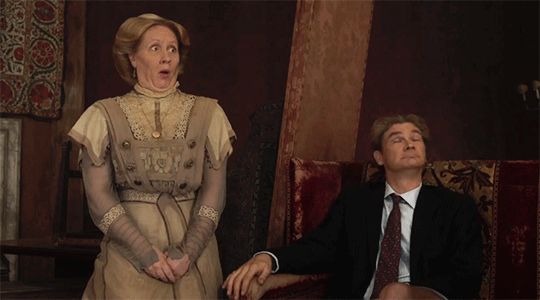
By then, as he said it, the Captain realised that there was one moment still to come if Fanny had dropped her demons and had ceased to be the terror of the household. She seemed much more at ease and that worried him greatly, as he thought of Mary before she ascended and of Kitty and how the glow shone around her when she too was taken.
When would it be for Fanny? The very thought of losing her concerned him more than ever!
How many did you find?



 THE GCSE & GCE ENGLISH PORTAL
You must be logged in to post a comment.